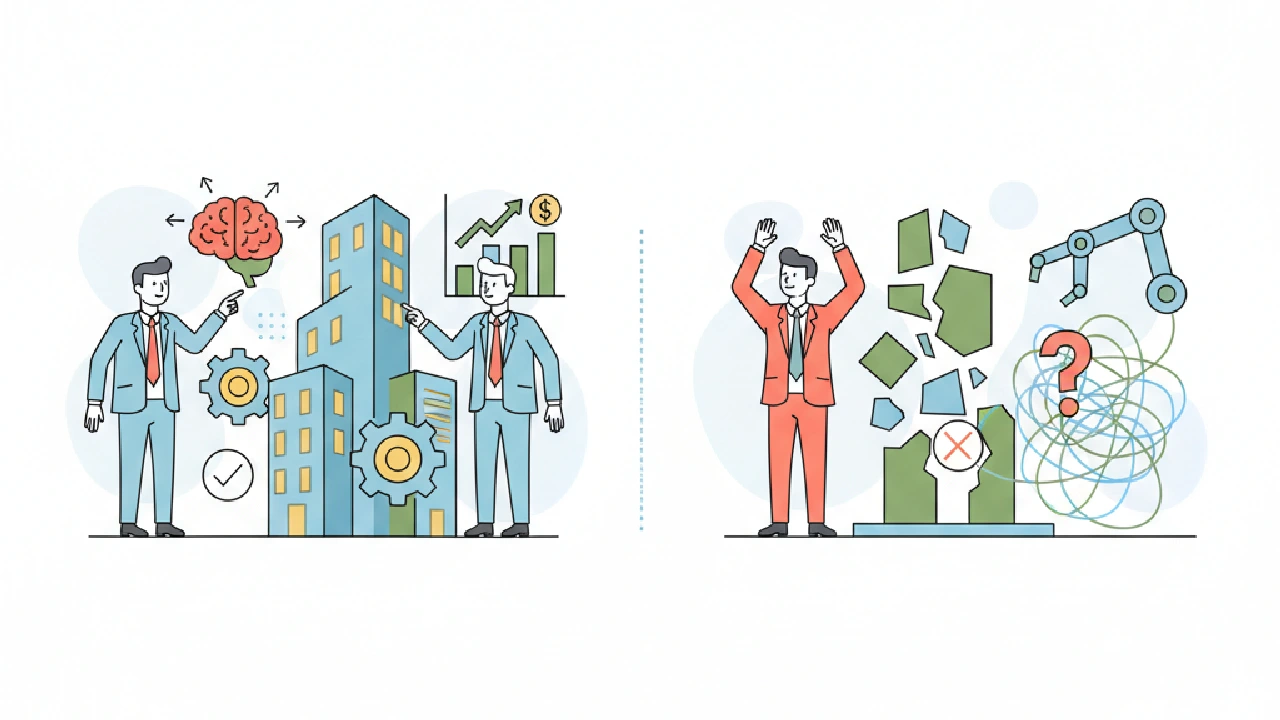
Let's talk AI in commercial real estate. We've all heard the hype. But if you're like us, you want to know what actually moves the needle, not just what sounds good at a conference. We're talking about real dollars saved or deals closed faster. Forget the sci-fi; let's look at what's actually happening on our desks right now.
Picture this: You've got a fresh offering memo (OM) on your desk. It's 150 pages, and you need to get a preliminary underwriting done by end of day. Five years ago, that meant hours of digging, re-keying data, and praying you didn't miss a critical clause in one of the boilerplate leases. Today? That's where AI starts earning its keep. It's not going to close the deal for you, but it’s making that initial grind a lot less painful.
The Document Cruncher: Where AI Shines Brightest
If there's one area where AI has undeniably changed the game, it's document processing. We're talking about the grunt work of extracting data from mountains of paperwork. Think about all those OMs, rent rolls, T-12s, and leases. AI tools are built for this.
It used to be that you'd spend hours manually pulling out key terms from complex or even those gnarly old typewritten leases. Now, specific AI tools can abstract those terms in seconds. This isn't just about speed; it's about accuracy and consistency across your entire portfolio. For compliance and tracking lease obligations, this is huge. It frees up your junior analysts from mind-numbing data entry and lets them focus on actual analysis.
Consider an international real estate portfolio. Each country might have slightly different lease conventions, local regulations, and even language. An AI document cruncher, with proper training and localized models, can handle this complexity far better and faster than a human team. It can flag clauses that might be standard in one region but highly unusual or even non-compliant in another, providing a critical early warning system for legal and compliance teams. Think about the due diligence phase for a multi-jurisdictional acquisition – the time and cost savings here are astronomical.
But here’s the kicker: it doesn't make you lazy. It makes you smarter. The AI churns out the first pass, but you still need to validate its work. It flags inconsistencies, sure, but the human eye and understanding of market nuances are still critical to catching errors and understanding context. Don't ever trust it blindly; verify, always.
An edge case scenario highlights this: imagine a lease rider negotiated years ago, perhaps handwritten, overriding a standard clause. A basic AI might miss the nuance or even misinterpret the handwritten addendum. An advanced AI, however, especially one trained on a broader dataset including historical and "messy" documents, could flag it for human review, noting the discrepancy and presenting both the original and the overridden clause. This human-AI collaboration ensures both speed and accuracy.
Before You Automate This, Check This:
- Is your data input clean? Garbage in, garbage out still applies. This includes scanning quality for physical documents.
- Are your workflows set up to integrate the AI's output seamlessly? (e.g., does it feed directly into your ARGUS model or property management system?)
- Do your analysts understand *how* the AI is pulling data, so they can spot errors and interpret flagged items correctly?
- Have you invested in training the AI on your specific document types and terminology? Generic AI tools may struggle with highly specialized CRE language.
- What mechanisms are in place for human feedback to continuously improve the AI's accuracy over time?
First-Pass Underwriting: A Force Multiplier, Not a Replacement
Underwriting and deal analysis have seen a massive boost from AI. Purpose-built tools can now ingest those OMs, rent rolls, and T-12s, and spit out a first-pass analysis. They will flag potential issues and inconsistencies way faster than we ever could.
This isn't about replacing the analyst. Far from it. It's about giving them a turbo-boost. Instead of spending the first day just getting the numbers into a usable format, they can dive straight into scenario analysis and risk assessment. AI handles the initial data extraction, allowing your team to jump to the higher-value work. We've seen this reduce the initial setup time on deals by hours, sometimes days.
Consider a large portfolio acquisition with dozens or even hundreds of properties. Manually reviewing each property's financials for due diligence is a monumental task. AI can rapidly aggregate and normalize data across all assets, identifying outliers in revenue, expenses, or lease terms that warrant deeper human investigation. This allows the acquisition team to prioritize their efforts, focusing on the properties with the highest potential risks or opportunities, rather than sifting through endless spreadsheets for every single asset.
However, and this is crucial, the AI generates a *first pass*. You, or your team, still own the final model. You're responsible for validating every input and making the ultimate judgment calls. These tools are fantastic for identifying undervalued opportunities or predicting market behavior by crunching local trends, demographics, and comps. But the credit decision? That's still yours. The nuanced market read? That's still yours. AI provides the data points; you connect them into a coherent strategy.
An operator angle to consider is the ability to run rapid "what-if" scenarios. An AI can quickly adjust assumptions like interest rates, vacancy rates, or CapEx budgets across an entire portfolio and show the immediate impact on projected returns. This empowers decision-makers to react much faster to changing market conditions or to test various investment strategies with unprecedented agility. It moves the conversation from "can we model this?" to "what does the model tell us if X, Y, or Z changes?"
Before You Trust an AI Underwrite, Check This:
- Have you cross-referenced the AI's data extraction with the raw documents? Pay particular attention to non-standard clauses or tenant inducements.
- Are the assumptions baked into the AI's model aligned with your investment strategy and risk tolerance? Do you understand the algorithms' underlying economic models?
- Does your team have a clear process for scrutinizing and overriding AI-generated flags and assumptions? How are these overrides documented for audit trails?
- Can the AI tool integrate with your existing financial modeling platforms (e.g., Excel, ARGUS, MRI)? Seamless integration is key to efficiency.
- What mechanisms are in place to update the AI's knowledge base with new market data, regulatory changes, and evolving investment criteria?
Market Intelligence & Operations: Beyond Spreadsheets
AI isn't just for deal-making; it's also impacting how we understand markets and run our properties. Machine learning models are now cross-referencing everything from local economic indicators to demographic shifts and comparable sales. This allows us to identify potential undervalued assets or get a better read on future market behavior. It’s moving beyond just static comps and into dynamic predictions.
Consider the granular level of data AI can process for market intelligence. Instead of just looking at average rents, AI can analyze social media sentiment, public transportation ridership patterns, local business openings and closings, and even subtle changes in zoning applications. This creates a much richer, more predictive understanding of submarket health and future growth areas. For example, an AI might detect an increase in younger, tech-savvy residents moving into a specific urban neighborhood by analyzing public transport data and new business registrations, signaling a demand shift for specific retail or co-working spaces years before traditional market reports would identify it.
On the operations side, AI is proving invaluable for predictive maintenance. Instead of waiting for an HVAC unit to break down in the middle of summer, AI-powered systems monitor building systems and alert us to potential issues before they become costly failures. This reduces operational costs and prevents tenant headaches. Plus, it's helping us identify expanding companies (tenant intelligence), making our leasing efforts more targeted.
Beyond HVAC, predictive maintenance can extend to elevator systems, plumbing, electrical grids, and even common area wear and tear. Imagine an AI system analyzing foot traffic patterns in a retail center, predicting which flooring sections will need replacement sooner, allowing for proactive maintenance and minimizing disruption to tenants and shoppers. For a large portfolio owner, the aggregated savings from reduced emergency repairs and optimized maintenance schedules across hundreds of properties can be substantial.
Tenant intelligence, powered by AI, goes beyond simply looking for expanding companies. It can analyze industry trends, public financial statements, news articles, and even employee reviews to predict tenant churn or growth potential. For instance, an AI might flag a major tenant in your office building whose industry is experiencing significant disruption, prompting your leasing team to proactively engage with them about future needs or begin backfilling strategies. Conversely, it could highlight a rapidly growing startup tenant that might soon need more space, presenting an expansion opportunity within your portfolio.
The key here isn't just having the data; it's how you operationalize it. Many firms are buying tools, but the real advantage comes from those who build the supporting data infrastructure to make this intelligence actionable. It's not just about a pretty dashboard; it's about changing how your team reacts to and uses that information.
An "operator angle" specifically regarding energy efficiency is also emerging. AI can analyze real-time energy consumption data alongside weather patterns, occupancy levels, and building specifications to identify inefficiencies and suggest optimal settings for lighting, heating, and cooling. This isn't just about minor adjustments; it can lead to significant reductions in utility costs and contribute to sustainability goals, crucial for ESG reporting and attracting eco-conscious tenants and investors.
Before You Implement Operational AI, Check This:
- Is your existing data infrastructure robust enough to feed these AI tools with real-time, high-quality data from disparate sources (BMS, utility meters, CRM)?
- Do you have clear protocols for how your team will act on AI-generated insights and alerts? (e.g., who is responsible for verifying a predictive maintenance alert and scheduling a repair?)
- Are you focused on specific, measurable outcomes (e.g., HVAC downtime reduction, vacancy rate improvement, energy cost savings, tenant retention rate improvement)?
- How will you integrate AI-driven insights into your capital expenditure planning and budgeting processes?
- What security and privacy measures are in place to protect sensitive operational and tenant data being processed by AI systems?
What AI Won't Do (Yet)
Let's be clear: AI is a powerful tool, but it's not a magic bullet. There are critical areas where human expertise, intuition, and relationships remain absolutely indispensable in commercial real estate.
Negotiation and Relationship Building
You can train an AI model on thousands of lease agreements, sales contracts, and term sheets. It might even identify optimal negotiation ranges based on historical data. But it cannot sit across the table from a seasoned broker or principal, read their body language, understand their unspoken motivations, or build the rapport necessary to close a complex deal. Real estate is fundamentally a people business. Deals are often won or lost based on trust, personality, and the ability to find creative solutions that satisfy multiple stakeholders, not just the party with the most data points. An AI can inform your negotiation strategy, but it cannot execute it with human finesse. It won't know when to push, when to concede a minor point to gain a major one, or how to bridge a communication gap between two strong personalities. These are uniquely human skills that AI is nowhere near replicating.
Understanding "Unstructured" Context and Market Sentiment
While AI excels at processing structured and semi-structured data, it still struggles with truly unstructured, qualitative context. Think about the "vibe" of a neighborhood, the local political climate, community activism surrounding a development, or the unquantifiable perception of a building's prestige. These factors significantly influence property values and investment decisions but are incredibly difficult for an AI to fully grasp. A human investor might hear whispers about a new zoning initiative, observe changes in local consumer behavior, or sense a shift in public opinion about a particular type of asset, none of which might be reflected in readily available data. AI can analyze news articles and social media, but interpreting the *implications* of that information in a nuanced, forward-looking way still requires human judgment and local market immersion.
Strategic Vision and Innovation
AI can optimize existing processes, analyze trends, and even suggest opportunities based on patterns. But can it conceive of an entirely new asset class? Can it envision a groundbreaking mixed-use development that transforms an entire urban core? Can it identify a paradigm shift in how people live, work, or shop that fundamentally changes real estate demand? Not yet. Innovation, strategic vision, and the ability to disrupt existing models require creativity, foresight, and a willingness to take calculated risks that go beyond historical data. AI is an exceptional tool for analysis *within* predefined frameworks; it is not, at this stage, an architect of entirely new frameworks for the industry.
Ethical and Reputational Judgment
Real estate often involves complex ethical considerations, community impact, and reputational risks. An AI can calculate the financial implications of a decision, but it cannot weigh the moral implications of displacing a long-standing community for a new development, or the reputational fallout from partnering with a controversial entity. These decisions require human values, ethical frameworks, and an "understanding" of societal impact that AI simply does not possess. Furthermore, ensuring fairness and preventing bias in AI models, especially when dealing with aspects like tenant screening or loan applications, is a human responsibility. Blindly trusting an AI without considering its ethical implications can lead to unintended harmful consequences and significant reputational damage.
Where a CRE-specific tool helps
While AI tackles the heavy lifting of data processing, a specialized commercial real estate platform can help you operationalize those insights and manage the human workflows that AI can't touch. For instance, after an AI fast-tracks your initial underwriting, you still need to actively manage the deal. Tools with features like an Investment pipeline and an Action Center can ensure that next steps and follow-ups are never missed, keeping deals on track and preventing opportunities from falling through the cracks.
Conclusion: AI as Your Co-Pilot, Not Your Captain
The message is clear: AI is not here to replace CRE professionals. It is a powerful co-pilot.
Where a CRE-specific tool helps
While AI tackles the heavy lifting of data processing, a specialized commercial real estate platform can help you operationalize those insights and manage the human workflows that AI can't touch. For instance, after an AI fast-tracks your initial underwriting, you still need to actively manage the deal. Tools with features like an Investment pipeline and an Action Center can ensure that next steps and follow-ups are never missed, keeping deals on track and preventing opportunities from falling through the cracks.
Conclusion: AI as Your Co-Pilot, Not Your Captain
The message is clear: AI is not here to replace CRE professionals. It is a powerful co-pilot.
Key Takeaways
- AI excels at document processing and first-pass underwriting: It automates data extraction from OMs, rent rolls, and leases, significantly speeding up initial analysis and freeing human analysts for higher-value work.
- Human oversight is crucial: Always validate AI-generated output, especially in document abstraction and underwriting. AI provides the data points, but human judgment and market nuance are still essential for final decisions.
- AI enhances market intelligence and operations: It can identify trends, optimize energy efficiency, and power predictive maintenance, leading to cost savings and better property management.
- AI cannot replace human skills in CRE: Negotiation, relationship building, understanding unstructured context, strategic vision, and ethical judgment remain firmly in the human domain.
- CRE-specific tools operationalize AI insights: Platforms like CREflow's Investment pipeline and Action Center help manage the workflows that connect AI-driven analysis to actual deal progression and follow-up.
FAQ
Can AI truly replace commercial real estate brokers or investors?
No, AI is a powerful tool to assist CRE professionals, but it cannot replace human intuition, relationship-building, negotiation skills, strategic vision, or ethical judgment. It acts as a co-pilot, enhancing efficiency and analysis.
What types of documents can AI systems process in CRE?
AI excels at processing structured and semi-structured documents common in CRE, such as offering memorandums (OMs), rent rolls, T-12 financial statements, and lease agreements. It can extract key data points and identify inconsistencies.
How does AI help with underwriting in commercial real estate?
AI tools can ingest financial documents and provide a rapid first-pass underwriting analysis, flagging potential issues and inconsistencies much faster than manual methods. This allows human analysts to focus on scenario analysis and risk assessment, though final validation remains critical.
Are there any downsides or risks to using AI in CRE?
Yes, potential downsides include the "garbage in, garbage out" problem with poor data quality, the need for continuous human validation, challenges with truly unstructured context, and the inability of AI to handle nuanced human elements like negotiation and ethical judgment. Security and privacy of sensitive data also require careful consideration.
How do specialized CRE platforms work with AI-generated insights?
Specialized platforms help operationalize AI insights by providing structured workflows. For example, after AI identifies a promising opportunity, CREflow can help you manage the deal through an Investment pipeline and ensure all follow-up tasks are tracked in the Action Center, turning insights into actionable steps.