We once chased a multi‑million‑dollar assignment that ate nearly all the junior team's bandwidth for months before it died at LOI. That failure taught us more than any course: the cre sales cycle is brutal when you don’t map it and enforce discipline.
In this piece I map the cre sales cycle clearly. No marketing fluff. No theory. You’ll get the seven stages most CRE teams move through, the real choke points, and exactly what to do at each stage to keep deals moving.
Core idea — treat the CRE sales cycle like an industrial process
The cre sales cycle is repeatable and long. Industry practice shows a typical window of 3 to 18 months from first contact to close. Treat each stage as a gate with pass/fail criteria — if a lead can’t meet the gate, move on. Discipline saves time and prevents wasted labor.
Stage map: the 7 repeatable stages and what to do
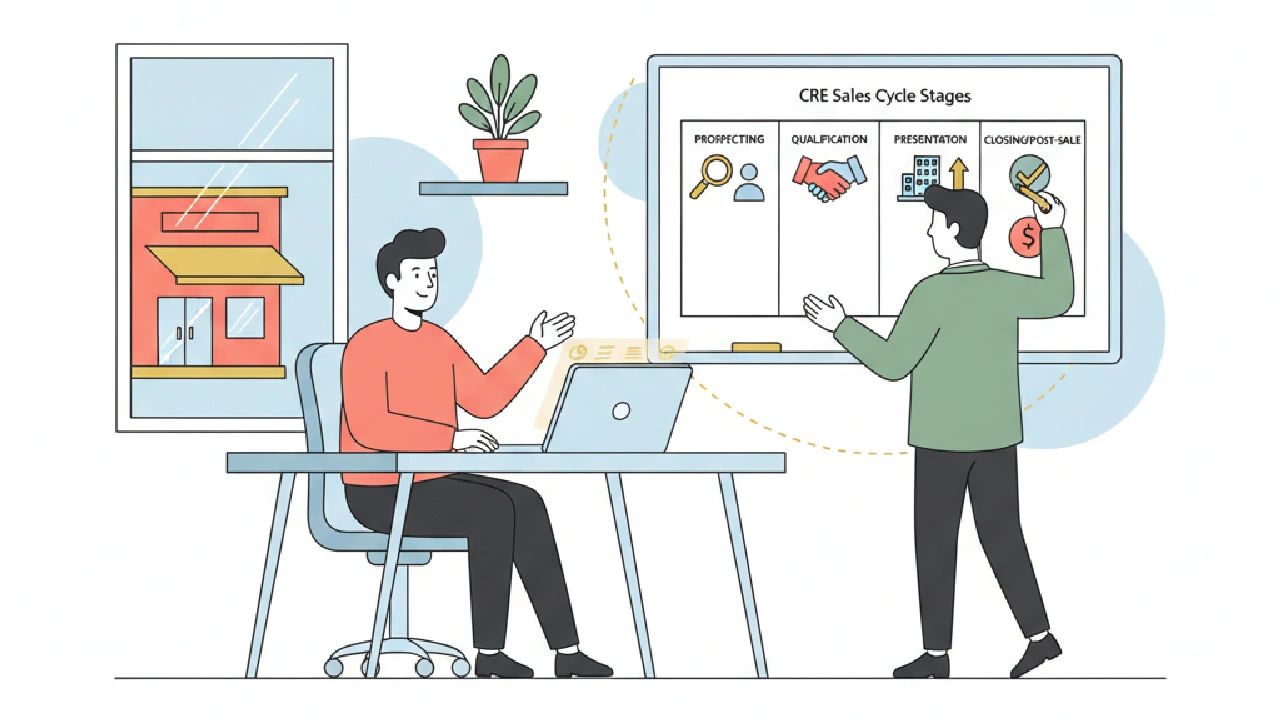
Think of this as a one‑page SOP for your deal team. The cre sales cycle follows seven stages. Below: each stage’s purpose, the single metric to own, and the practical step that moves a deal forward.
1) Prospecting — feed the top of the funnel
Purpose: find potential buyers, sellers, or tenants that match your target profile. Win probability at this early phase is low — a reasonable working figure is 10–15% for prospects that progress past initial outreach.
Metric: qualified leads entered into the CRM per month.
Do this: stop shotgun marketing. Build lists based on real investment profiles and push only targets that meet your minimum criteria into active outreach. Make cold outreach measurable: two timed attempts, then pause and move the record to a nurture track unless they respond. Use focused cold outreach scripts and templates for brokers to increase response and consistency.
2) Contacting — make real contact fast
Purpose: convert a name into a meeting or an explicit yes/no. Fast contact separates serious players from noise.
Metric: contact‑to‑meeting conversion within your chosen cadence.
Do this: set a two‑day rule. If you can’t get a response from your initial sequence, move the record into a tailored nurture track. Don’t let reps keep contacts in spreadsheets hoping they’ll call back someday — move off spreadsheets to a CRM to keep activity visible and enforce follow‑up.
3) Qualifying — the ruthless filter
Purpose: confirm budget, timeline, decision authority, and deal fit. This stage is where you say no more often than yes.
Metric: qualified opportunities that meet your buybox.
Do this: use a short qualifying template. Ask budget range, capital source, decision steps, and a hard timeline. If any answer fails the template, disqualify or reclassify as long‑term nurture. Solid qualification reduces downstream churn in diligence.
4) Presenting — show the asset and your solution
Purpose: get the stakeholder to imagine owning or leasing the asset. This is credibility and fit building, not a verbose pitch.
Metric: presentation‑to‑LOI conversion.
Do this: keep presentations short and outcome‑focused. Use a concise packet, a quick site tour, and an async video when appropriate. End every presentation with a clear next step: term sheet, LOI, or an explicit list of items required to get to an LOI. Consider a concise listing pitch deck and talking points framework to sharpen your message.
5) Handling objections — move probability up
Purpose: answer risk questions and re‑establish price versus value. Proper objection handling moves win probability into the 60–80% range.
Metric: objections resolved per open issue list.
Do this: document every objection and turn them into a short punch list with owners and deadlines. Don’t let subjective concerns live in email threads. If a buyer needs rent comps, deliver comps. If they need lender comfort, call a capital partner and get a letter of interest.
6) Closing — contracts, signatures, and money moving
Purpose: turn a negotiated LOI into a signed contract and a funded close. This is where you execute paperwork and hand off to counsel and closing agents.
Metric: time from LOI to contract execution.
Do this: run an issues register and a closing calendar. Assign a transaction lead who owns dates and deliverables. Pre‑collect documents where possible to avoid last‑minute gaps that stall lenders or investors. Use dedicated software for tracking offers, LOIs, and closing to keep deadlines and versions straight.
7) Following up — retention, referrals, and re‑engagement
Purpose: convert closed deals into repeat business and referrals. The sale didn’t end when title transferred.
Metric: repeat client engagements tracked over a year.
Do this: trigger a post‑close outreach plan. Send a short recap, a checklist of operational next steps for the new owner or tenant, and a simple referral ask. Treat good closes as the start of a new pipeline. Hand off using an asset management checklist for post‑close handoffs so the new owner gets a clean operational start.
Where deals fall apart — the three real choke points
Most teams lose deals in predictable places. Fix these and you’ll move more deals to close.
Choke 1 — weak qualification
If you let unqualified leads into the active pipeline you waste due diligence bandwidth. Enforce a qualification gate and refuse to create opportunities in the CRM without completed qualification fields.
Choke 2 — unclear next steps after presenting
Too many presentations end with “we'll be in touch.” That sentence kills momentum. Every presentation must end with a clear, dated next step that both sides acknowledge.
Choke 3 — undocumented objections
Unrecorded objections are silent deal killers. They resurface late and torpedo trust. Log objections as line items with owners and dates and track them like any project task.
How to speed up the cre sales cycle without cutting corners
You can compress the cre sales cycle, but not by skipping diligence. Two practical levers work: stricter qualification and better workflow automation.
Qualification saves hours by keeping dead leads out of diligence. Workflow automation reduces handoff delay. Industry tech adoption shows automation can reduce deal cycles materially — some brokers report a 30% to 50% decrease with AI‑driven workflows, and broader analyses cite a 31% reduction when priority filters and automation are applied to pipeline management.
Do this: remove manual copy‑paste handoffs. Use a single source of truth (your CRM) and automate tasks: document requests, reminders, and status updates. Set SLA windows for each gate and enforce them.
Mini‑case: a simple play that saved our team sanity
We had an asset that showed interest from three buyers. Instead of juggling email threads, we created a one‑page issues register and ran a two‑week sprint to address the top five items the buyers raised. Result: faster LOIs and one cleaner close. The tactic was simple: centralize issues, assign owners, set deadlines.
Where a CRE‑specific tool helps
A few workflow gaps consistently slow deals: unclear next steps, missed follow‑ups, and handoff delays. A CRE‑specific platform that supports Investment pipeline management, a prioritized Action Center, and deal‑stage trigger automation makes those failure modes visible and enforceable — so next steps are always owned and tracked.
- Use the Investment pipeline and deal‑stage automation to create required follow‑ups when a stage changes.
- Work a prioritized queue in the Action Center so overdue items and property follow‑ups don’t get hidden.
See how you can manage your pipeline in CREflow.
Key takeaways
- Treat the cre sales cycle as seven gates: prospecting through follow‑up, each with clear pass/fail criteria.
- Enforce ruthless qualification — industry win probability at initial prospecting is roughly 10–15%.
- Document objections and own them; when objections are actively resolved, win probability rises to about 60–80%.
- Use automation and workflow rules to compress cycles; brokers report a 30% to 50% decrease with AI tools, and broader analyses note a 31% reduction with priority filters.
FAQ
How long is the typical cre sales cycle?
Expect it to be long. The common range in practice runs from 3 to 18 months from first contact to close. Plan staffing and pipeline coverage around that reality.
What stage should I focus on to move more deals forward?
Focus on qualification and objection handling. Qualification keeps your team from wasting time. Clear, documented objection work increases win probability significantly.
Will automation replace brokers?
No. Automation speeds processes and removes friction, but the core relationship work — negotiation, credibility, capital matching — still requires humans. Use automation to enforce discipline, not to replace judgment.
How should we measure sales cycle length?
Measure average days from opportunity creation to close for closed deals. Track it and segment by deal type. Use that number to set realistic timelines for new opportunities.
Before You Map This, Check This:
- Do you have a clear buybox template? If not, write one now.
- Is your CRM the single point of truth, or do spreadsheets still hold active tasks?
- Do you log objections as issues with owners and deadlines?
- Do you enforce a contact cadence and a two‑day response rule for new leads?
- Do you have an automation playbook for routine handoffs and document requests?
If you fix those five items, your cre sales cycle will become far more predictable. That predictability is the real edge in a slow market: the ability to allocate time and capital where it actually earns returns.