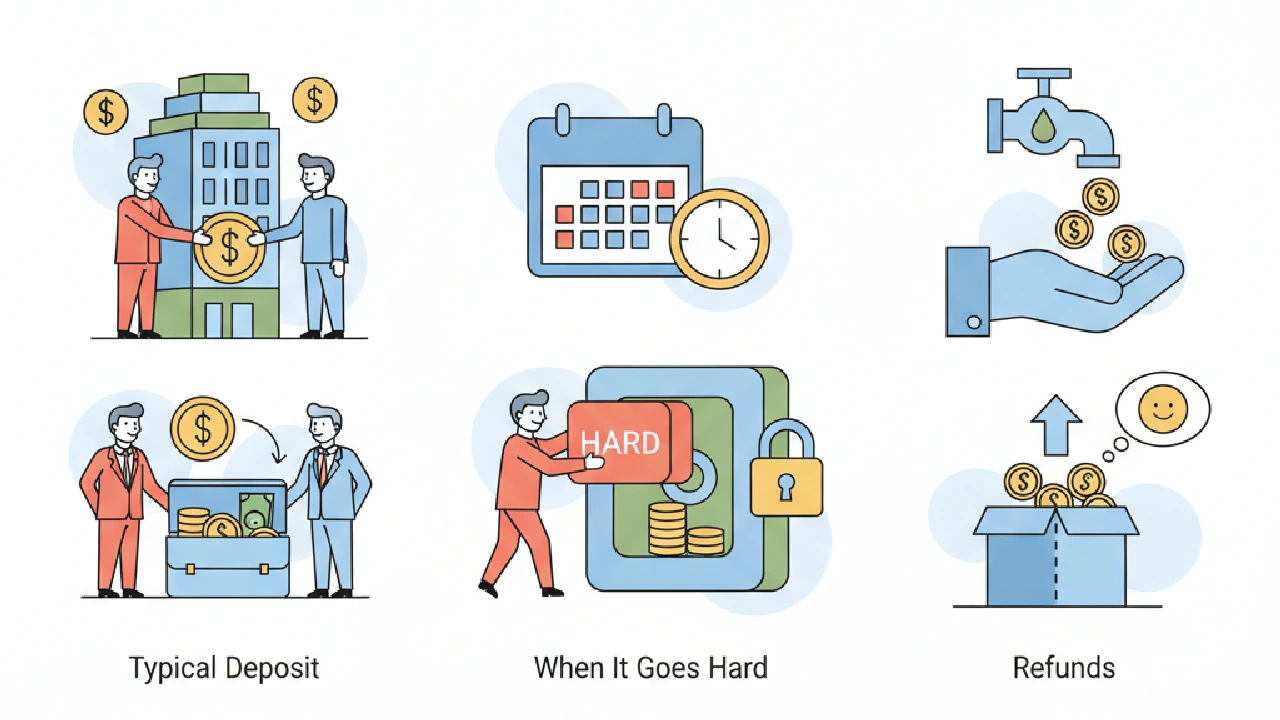
Earnest money in commercial real estate is the good-faith deposit a buyer puts into escrow after signing the purchase and sale agreement (PSA). The amount is negotiated deal by deal, it is usually refundable during the due diligence period, and it typically "goes hard" (becomes nonrefundable) when that period ends. At closing it is credited toward the purchase price. This guide walks small acquisition teams and individual investors through typical deposit sizes, staged deposits, escrow, and when you get the money back or lose it.
It is written for buyers moving from a letter of intent (LOI) to a signed PSA. It is general information, not legal advice. Your PSA's exact wording controls, so have your attorney review the deposit and default sections before you sign.
How Much Earnest Money Is Typical in Commercial Real Estate?
There is no standard number. Published practitioner guidance varies a lot, which is itself a useful signal that the deposit is a negotiating point:
- Attorneys presenting at an ICSC workshop on retail purchase and sale agreements wrote that, in their experience, deposits are usually between 3% and 5% of the purchase price, with significant variation.
- A 2025 article from the law firm Baker Donelson says it is typical for commercial contracts to require between 10% and 20% of the purchase price as the deposit.
The same ICSC materials note why the range is so wide. Some buyers offer a very large deposit to stand out in a competitive process, and some sellers insist on one to test commitment. Buyers whose deal depends on a rezoning or other entitlements often push for a small deposit because of what it costs to get to closing.
In practice, the deposit size trades off against other terms. A seller who cares most about certainty may accept a lower price from a buyer who posts more money, or money that goes hard sooner. A buyer with leverage (an off-market deal, a property with known problems) can often keep the deposit small and the diligence window long. Only offer a deposit you can afford to lose if your diligence team cannot finish on time.
Soft Money vs. Hard Money: The Deadline That Matters Most
Soft money is the deposit while it is still refundable, usually during the due diligence or inspection period. Most PSAs let the buyer terminate during that window. The ICSC materials describe inspection periods that commonly run 30 to 90 days and that, in many PSAs, let the buyer cancel for any reason or no reason. If you terminate in time and in the way the contract requires, the escrow holder returns the deposit.
Hard money is the deposit after it becomes nonrefundable. That usually happens when the due diligence period expires without a valid termination notice. After that point, if you fail to close for a reason the contract does not excuse, the seller can generally keep the deposit. In competitive markets, a deposit can be negotiated to go hard earlier, sometimes immediately on deposit.
The go-hard date is the most important deadline in the PSA. Every report you rely on (title, survey, environmental, property condition, lease review) needs to be back and reviewed before it. Working from a commercial real estate due diligence checklist helps you order the long-lead items first. Shared due diligence tools can tie each report to that date, so nothing is still open when it passes.
Staged Deposits and Extension Deposits
Many commercial deals split the deposit into stages instead of wiring everything on day one. Baker Donelson notes that the initial deposit is often due on signing and that a seller may ask for an additional deposit later, such as when the due diligence period expires. A common shape looks like this:
- Initial deposit: wired to escrow within a few days of the PSA's effective date and refundable during diligence.
- Additional deposit: due when the due diligence period ends, at the same time the initial deposit goes hard.
- Extension deposit: an extra amount paid if the buyer uses a contract right to extend diligence or closing. It is often nonrefundable and applied to the price.
Put the deposit amounts, due dates and refund triggers in the LOI, not just the PSA. The ICSC authors call it a mistake when LOIs skip the detail of when deposits become nonrefundable, because the issue then has to be fought out while drafting the PSA. If you are juggling several rounds of terms, keep a clear record of LOIs and counter-offers so the agreed deposit schedule carries into the contract unchanged. Our LOI templates post shows where deposit terms usually sit.
Who Holds the Deposit
The deposit goes to an escrow agent named in the PSA, not to the seller. Baker Donelson notes the deposits are often held by the buyer's title company. The escrow agent follows the escrow instructions in or attached to the contract, which spell out how funds are received, held and released. Points worth negotiating:
- Interest: whether a large deposit sits in an interest-bearing account, and who gets the interest.
- Release on termination: whether the escrow agent can return your deposit on your notice alone, or whether the seller gets a short window to object first.
- Escrow fees: who pays them, which the contract or local custom decides.
Before you wire anything, confirm the wire instructions by phone using a number you already know, not one from the email. The FBI warns that criminals impersonate title companies, attorneys and agents to redirect real estate wires; see its business email compromise guidance and the IC3 public service announcement, which also says what to do if a wire goes to the wrong account.
Soft vs. Hard Phase at a Glance
| What changes | Before the deposit goes hard | After the deposit goes hard |
|---|---|---|
| Deposit risk | Refundable if you terminate on time and as the PSA requires | Generally kept by the seller if you fail to close without a contract excuse |
| Main work | Title, survey, environmental, property condition and lease review | Loan closing, equity wires, closing statement |
| Key paperwork | Title and survey objections, termination or extension notices | Loan commitment, settlement statement, entity documents |
| What to watch | The exact expiration date, time and notice method | Closing date and any extension rights |
Example: How a Deposit Goes Hard by Accident
This is a made-up example to show the mechanics, not a real deal. A buyer signs a PSA on a $4,000,000 industrial flex building. The contract calls for a $50,000 initial deposit at signing, a 30-day diligence period, and a second $50,000 deposit when diligence ends, at which point the whole $100,000 is hard.
The survey arrives late, on day 29, and shows an easement across the planned parking area. The buyer emails the broker asking for "a couple more days" and assumes that is enough. It is not. The PSA requires a signed amendment or a written termination notice delivered to specific people. Day 30 passes, the $50,000 initial deposit goes hard, and the second deposit comes due. The buyer now has to choose between walking away and losing $50,000, or closing on a property with a site problem.
The fix is boring: calendar the expiration date and time the day the PSA is signed, set reminders well before it, and send extension requests or termination notices exactly the way the notice section requires. In CREflow Pro, teams can keep these dates as tasks with follow-up reminders on the deal so everyone sees the same deadline.
When You Get the Deposit Back and When You Lose It
When the buyer usually gets it back
The ICSC materials and Baker Donelson list situations buyers commonly negotiate as refund triggers, even after the deposit is otherwise nonrefundable:
- You terminate before the due diligence period ends, in the way the PSA requires.
- The seller defaults, or materially misrepresents the property.
- The seller cannot or will not cure a title or survey defect you objected to on time.
- A casualty or condemnation leads to the contract being terminated.
- A closing condition fails that was not caused by the buyer.
Tenant estoppels can matter here too. If a signed estoppel certificate shows rent or lease terms that differ from what the seller represented, check what your PSA says you can do about it.
When the seller usually keeps it
Once the deposit is hard, the seller generally keeps it if the buyer fails to close for a reason the contract does not excuse. Common causes are financing that falls through (unless the PSA has a financing contingency that still applies), equity partners who do not fund on time, or a buyer who simply changes their mind after the deadline.
Many commercial PSAs say the deposit is the seller's liquidated damages if the buyer defaults, which can limit what else the seller can claim. Whether that is true in your deal depends entirely on how your contract is written, so ask your attorney to confirm it before signing.
What Happens to the Earnest Money at Closing?
If the deal closes, the deposit is not an extra cost. As the ICSC materials put it, earnest money is applicable to the purchase price: the escrow agent credits it, plus any interest the contract gives you, toward what you owe at closing. Check the settlement statement to make sure every deposit, including any extension deposits that were meant to apply to the price, shows up as a credit. Some extension payments are written as fees that do not apply to the price, so confirm which kind yours is in the PSA.
Before You Wire: A Short Checklist
- Confirm the wire instructions by phone with the escrow agent, using a number you already have.
- Write down the exact time and time zone when diligence expires.
- Know the notice method the PSA requires (email allowed or not, and who must receive it).
- Order long-lead reports (survey, environmental, property condition) in the first days of diligence.
- Confirm which deposits apply to the price and whether interest is credited to you.
- Have your attorney review the refund triggers and the default and remedies section.
Key Takeaways
- Earnest money amounts are negotiated. Published practitioner ranges run from about 3% to 5% up to 10% to 20% of the price.
- The deposit is usually refundable during due diligence and goes hard when it ends, so that date drives your whole diligence plan.
- Staged deposits and clear refund triggers belong in the LOI as well as the PSA.
- An escrow agent, often the title company, holds the money. Verify wire instructions by phone.
- If the deal closes, the deposit is credited toward the purchase price.
Before you post a deposit, make sure the numbers work. Run the deal through the free CREflow Pro underwriting calculator, then see CREflow Pro plans if you want your deals, deadlines and tasks in one place.
FAQ
What is a typical earnest money deposit for commercial real estate?
There is no standard. ICSC workshop authors put it usually at 3% to 5% of the price, while a Baker Donelson article says 10% to 20% is typical. The real number depends on competition, deal risk and how long the buyer needs for diligence.
Is earnest money refundable in commercial real estate?
Usually yes during the due diligence period, if you terminate on time and as the PSA requires. After the deposit goes hard, it is generally refundable only for reasons the contract lists, such as a seller default or an uncured title defect.
What does it mean when earnest money goes hard?
It means the deposit has become nonrefundable, usually because the due diligence period ended. After that, the seller can generally keep it if the buyer fails to close without a contract excuse.
What is the difference between earnest money and a down payment?
Earnest money is the deposit you post after signing the PSA to show good faith. The down payment is the equity you bring at closing. The earnest money is credited toward the purchase price, so it becomes part of what you pay at closing.