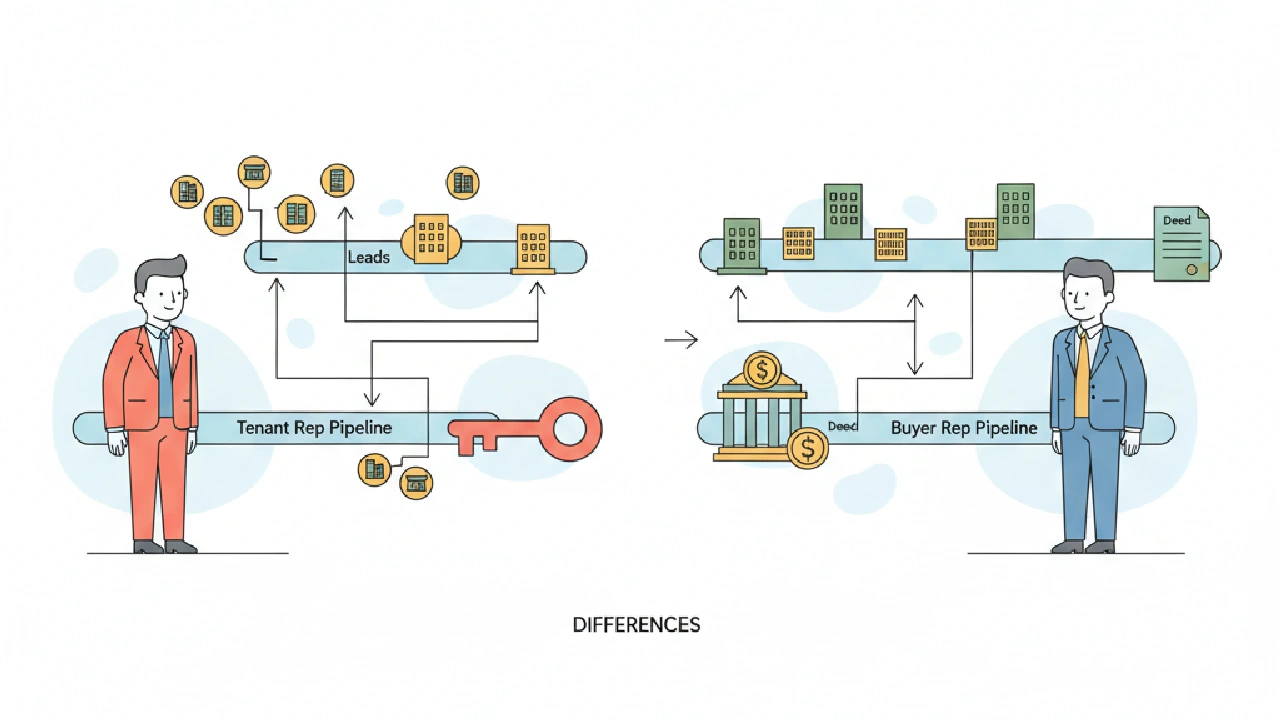
You're looking at a deal, say a 20,000 SF flex space. As a tenant rep, your brain immediately goes to monthly rent, CAM, and how quickly you can get your client in. As a buyer rep, you're running cap rates and debt yield before you even finish your coffee. While both roles are about matching clients with commercial real estate, the pipelines – how we source, qualify, and close deals – are fundamentally different. Ignoring these distinctions costs you time, money, and maybe a few good nights' sleep.
We've seen too many operators try to apply the same playbook to both. It just doesn't work. Let's cut through the noise and look at what actually drives these two distinct pipelines.
The Core Idea: Driver vs. Return
A tenant rep prioritizes occupancy cost, location fit, and operational flexibility. You're selling a solution to an immediate business need. Your client needs a place to operate, and fast. Days on Market (DOM) is a huge factor for you; every day a client isn't in space, they're losing money or stalling growth. We're talking about securing space quickly – often under 120 days for liquidity.
On the flip side, as a buyer rep, our focus shifts entirely. We advocate for an entity purchasing commercial real estate, prioritizing investment return, asset quality, and long-term value appreciation. Our clients are thinking about cap rates, debt yield, and how this asset fits into a broader portfolio strategy. Speed is a factor, but not at the expense of a sound investment.
What Drives Your Deal Flow?
Tenant Rep: Occupancy, Speed, and Submarket Life
For us on the tenant rep side, the pipeline is all about finding the right functional fit and managing the clock. Our clients need space to do business, plain and simple. We're constantly watching submarket occupancy trends because that tells us where the activity is, where businesses are growing, and where our clients will thrive. It's not just about what's available, but what kind of business stability that submarket offers.
A critical metric here is occupancy cost. It's not just the base rent; it's the CAM, the tax escalations, and understanding the total burn rate for that space. We've learned the hard way that missing those hidden costs can kill a deal or, worse, sour a client relationship. The pressure to move quickly (DOM low) means you often have to strike a balance between speed and getting the absolute perfect operational fit. That tightrope walk is a daily reality.
Consider an expanding tech startup needing 10,000 SF of office space. As a tenant rep, your first question isn't "what's the IRR?" it's "what's their headcount growth trajectory, their preferred commute times for employees, and their budget for all-in occupancy costs?" You're looking at flexible lease terms, expansion options, and submarkets with a strong talent pool. A great example of an edge case here is a client with highly specialized infrastructure needs, like a biotech firm requiring specific lab ventilation or a data center needing extreme power redundancy. The "perfect" location for their business might have higher occupancy costs, but the opportunity cost of not having that specific infrastructure is far greater. Your role is to quantify that trade-off for them.
Another angle for tenant representation is the concept of "stay vs. go" analysis. Many businesses considering a move are also weighing the option of renewing their current lease, perhaps with an expansion or renovation. Your pipeline here involves not just identifying new spaces but also robustly analyzing the financial implications of staying put, including potential TI allowances from their current landlord versus the costs of a full relocation. This often involves detailed financial modeling of downtime, moving costs, and new fit-out expenses – elements that a buyer rep wouldn't typically prioritize.
Before You Pitch a Space, Check This:
- What's the true, all-in occupancy cost including conservative estimates for escalations, potential TIs from the landlord, and the client's expected fit-out costs?
- How stable and diverse are the occupancy trends and business growth indicators in that submarket over the last 12-24 months? Does it align with your client's industry and projected longevity?
- Can we realistically get them in and operational, including permitting and construction, within their target timeline, and what are the penalties for delays?
- What are the implications for their workforce – commute, amenities, talent attraction?
- Does the lease offer flexibility for future growth or contraction, such as options for expansion, contraction, or early termination?
Buyer Rep: Cap Rates, Liquidity, and Long-Term Value
When we're repping a buyer, the whole game changes. We're looking for strategic investments, not just spaces. Cap Rate and Debt Yield are our North Stars. An 8.0% minimum for multifamily, 10.0% for office – these become critical benchmarks. Our clients are sophisticated investors, often with institutional mandates or high-net-worth portfolios. They're not just buying a building; they're buying an income stream, a future development opportunity, or a strategic foothold in a robust market.
The pipeline for a buyer rep demands exhaustive due diligence. We're dissecting leases, understanding tenant creditworthiness, analyzing operating expenses down to the last utility bill, and scrutinizing market comparable sales not just asking prices. We're stress-testing financial models against various market conditions and exit strategies. What happens if interest rates rise by 100 basis points? What if a major tenant vacates? These aren't hypothetical questions; they're core to our risk assessment.
Consider a client looking to acquire a multi-tenant retail strip center. As a buyer rep, you're not just looking at the current NOI; you're diving deep into the tenant mix. How long are the remaining lease terms? What are the renewal probabilities? What is the credit rating of the anchor tenant? Are there any co-tenancy clauses that could impact rent if a specific tenant leaves? An edge case here might involve a property with significant deferred maintenance, which could scare off less experienced buyers. Your role would be to quantify those costs, negotiate a favorable purchase price reduction, and articulate the value-add opportunity to your client, demonstrating how the investment in deferred maintenance can yield a higher cap rate post-stabilization.
Another operator angle often overlooked by new buyer reps is understanding the seller's motivation. Is it a distress sale? A 1031 exchange? A portfolio rebalancing? Knowing the seller's pressure points can significantly influence your negotiation strategy and help your client secure a better deal. For example, a seller under a tight 1031 timeline might be more amenable to a slightly lower offer for a quicker close. Conversely, a seller with no urgency might demand premium pricing, requiring your client to be patient rather than rush into an overvalued acquisition.
The long-term value component also extends to understanding zoning regulations and future development potential. Is there air rights potential? Can the property be repurposed in five or ten years? What are the planned infrastructure projects in the immediate vicinity that could enhance future property values? These factors contribute to a buyer's overall investment thesis and are far removed from mere occupancy cost analysis.
Before You Pitch an Asset, Check This:
- What is the current, in-place cap rate, and what is the pro forma cap rate based on your realistic projections for rent growth and expense management?
- How thoroughly has due diligence been conducted on all leases, operating expenses, environmental reports, and structural integrity?
- What are the short-term and long-term liquidity options for this asset, and how does it align with the client's portfolio strategy?
- What are the potential value-add opportunities: re-tenanting, redevelopment, operational efficiencies?
- What is the exit strategy, and how sensitive is the projected IRR to changes in market conditions, interest rates, or tenant stability?
- What is the competitive landscape for similar assets in this submarket, and what makes this particular asset a compelling investment?
Client Profile: Needs vs. Wants
The type of clients you attract and serve dictates your pipeline strategy heavily. A tenant rep client is typically a business owner or corporate real estate manager focused on operational continuity and finding the best space for their employees and operations. Their "want" is often speed and minimal disruption to their core business. Their "need" is a functional, cost-effective space that supports their growth. You're often dealing with internal stakeholders, committees, and timelines driven by lease expirations or expansion mandates.
A buyer rep client, in contrast, is an investor – an individual, a family office, a fund, or a REIT. Their "want" is a strong return on investment and portfolio diversification. Their "need" is a well-underwritten asset that meets their specific risk-reward profile. They require granular financial data, meticulous market analysis, and a deep understanding of investment vehicles and tax implications. They are often less concerned with the "feel" of a space and more with the numbers it generates.
Consider the communication styles. A tenant rep might spend more time on site tours, negotiating tenant improvement allowances, and coordinating move logistics. A buyer rep will spend more time in spreadsheets, reviewing legal documents, and presenting detailed financial models. An edge case here involves an owner-user looking to acquire a building for their own business operations. While they have an occupancy need, the acquisition component means both tenant rep and buyer rep skills come into play. Here, you'd be analyzing not just the occupancy cost but also the long-term equity build-up, potential for future rental income from extra space, and the tax advantages of ownership. This hybrid client requires a truly integrated pipeline approach, combining the speed and operational focus of tenant representation with the financial rigor of buyer representation.
The "Secret Sauce" of Each Pipeline
Tenant Rep: Market Intel & Relationships
Your "secret sauce" as a tenant rep lies in your deep, almost intuitive understanding of submarket dynamics and your robust network of landlords and listing brokers. You need to know not just what's available, but what's *coming available*, what deals are falling apart, and who's motivated to lease. This means constant communication with other brokers, staying on top of lease expiration dates across your target submarkets, and even understanding local permitting and construction lead times. Relationships with architects, space planners, and moving companies are invaluable for ensuring a smooth transition for your client. We've seen the value of having a reliable permitting expediter in a hot market – it can literally be the difference between hitting a deadline and significant penalty costs for your client.
Building your reputation as a tenant rep involves consistently delivering timely, cost-effective solutions. This often means going beyond just finding space and acting as a project manager for the entire move-in process – from lease negotiation to fit-out oversight. Your clients rely on you to mitigate operational risk, and that differentiates you from the competition.
Buyer Rep: Data, Diligence & Deal Sourcing
For buyer reps, the "secret sauce" is rooted in superior data analytics, meticulous due diligence, and a proactive deal sourcing strategy. This isn't about waiting for listings to hit the market; it's about identifying off-market opportunities, understanding ownership structures, and often, convincing owners who weren't actively selling to consider an offer. This requires sophisticated CRM systems, access to robust property databases, and a knack for uncovering hidden value. Your ability to model complex financial scenarios, identify potential risks, and present a compelling investment thesis is paramount. Being able to demonstrate that you've "left no stone unturned" in your due diligence instills confidence in your investor clients.
Furthermore, understanding the capital markets – equity sources, debt providers, and market sentiment – is critical. You're not just finding a property; you're helping your client secure the financing and structure the deal. Relationships with lenders, attorneys specializing in commercial real estate, and sophisticated investors are key to successfully closing complex transactions. A successful buyer rep often acts as a strategic advisor, guiding clients through market cycles and helping them identify the right timing for acquisitions and dispositions.
Leveraging specialized tools makes a tangible difference here. For instance, dedicated lease and broker deal workflows in CREflow offer distinct deal detail tabs and fields for tenant rep and buyer rep engagements. This means you're not trying to force a square peg into a round hole; your digital pipeline mirrors your real-world process, ensuring that the critical data points like lease terms, rent escalations, or underwriting metrics are always front and center, specific to the deal type you’re working.
Conclusion: Two Sides of the Same Coin, Different Tools
While both tenant representation and buyer representation operate within the commercial real estate ecosystem, their pipelines are built on entirely different foundations. Successfully navigating both requires a keen understanding of their unique drivers, client profiles, and "secret sauces." Trying to use a cap rate analysis playbook for a tenant seeking a flexible office lease is like bringing a butter knife to a steak dinner – it might make shallow cuts, but it won't get the job done properly. By recognizing and adapting to these fundamental differences, you'll not only close more deals but also build stronger, more appreciative client relationships, ultimately leading to a more profitable and less stressful career in CRE.
Ignoring these distinctions isn't just inefficient; it's detrimental to your long-term success. Master both, and you'll be an indispensable asset in the dynamic world of commercial real estate. Lean into the differences, refine your specialized skills, and watch your commercial real estate pipelines flourish in CREflow.
Streamlining workflows with specialized tools
As you manage the distinct demands of tenant rep and buyer rep pipelines, having tools that adapt to each workflow is crucial. Relying on generic CRM setups can lead to overlooked details and inefficiencies, especially when dealing with the granular data points unique to each type of deal.
For instance, managing a property shortlist for a tenant rep client involves tracking potential spaces, comparing occupancy costs, and noting unique client requirements. A buyer rep, however, needs robust tools for financial modeling, detailed due diligence tracking, and comprehensive comparable sales analysis. The data points relevant to one often have little bearing on the other, yet both are critical for successful deal closures.
Using a system that provides per-pipeline deal pages in CREflow means your interface changes to match the deal you are working on. This ensures that whether you are focused on lease-specific fields for a landlord-tenant deal or underwriting metrics for an investment acquisition, the relevant data is always front and center, eliminating the need for workarounds or external spreadsheets. This level of specialization helps brokers maintain focus on the metrics that matter most for each client, reducing the risk of errors and improving overall efficiency.
Key takeaways
- Tenant rep focuses on occupancy cost, location fit, and operational flexibility for clients with immediate business needs, prioritizing speed and submarket dynamics.
- Buyer rep prioritizes investment return, asset quality, and long-term value appreciation, heavily relying on cap rates, debt yield, and extensive due diligence.
- Client profiles differ significantly: tenant rep clients are businesses needing space, while buyer rep clients are investors seeking financial returns.
- Specialized tools, like broker mode and custom pipeline visibility in CREflow, are essential to manage the distinct data and workflows of each role effectively.
- Both roles require deep market intelligence, but tenant rep leans on relationships and market intel, while buyer rep relies on data, meticulous due diligence, and off-market deal sourcing.
FAQ
How do tenant rep and buyer rep prioritize different metrics?
Tenant reps prioritize metrics like occupancy cost, total square footage, and lease flexibility because their clients are businesses seeking functional space. Buyer reps prioritize financial metrics such as cap rates, debt yield, and internal rate of return (IRR) because their clients are investors focused on asset performance and financial returns. Both roles use different deal detail tabs and fields in CREflow that are tailored to their respective needs, ensuring the right information is always visible.
Can I use the same CRM for both tenant rep and buyer rep?
While a generic CRM can store contact information for both, it often struggles to support the distinct workflows and data requirements of each role efficiently. Platforms like CREflow offer specialized pipelines for investment, listing, buyer rep, landlord rep, and tenant rep deals. This allows you to track deal-specific data like lease terms for tenant rep or underwriting metrics for buyer rep, directly within the deal record, improving organization and reducing manual workarounds.
What are the key differences in due diligence for each role?
For tenant representation, due diligence often focuses on lease terms, tenant improvement allowances, operational costs, and the suitability of the space for the client's business operations. For buyer representation, due diligence is much more extensive, covering financial statements, market comparable sales, environmental reports, structural integrity, and tenant creditworthiness, with an emphasis on long-term investment value. The Checklist and Comps tabs in CREflow can help manage these varied due diligence tasks efficiently for both deal types.
How important is speed in each type of deal?
Speed is generally more critical in tenant representation because clients often face lease expirations or urgent operational needs, making "Days on Market" a significant factor. For buyer representation, while efficiency is valued, speed is secondary to thorough due diligence and securing a sound investment. A buyer rep