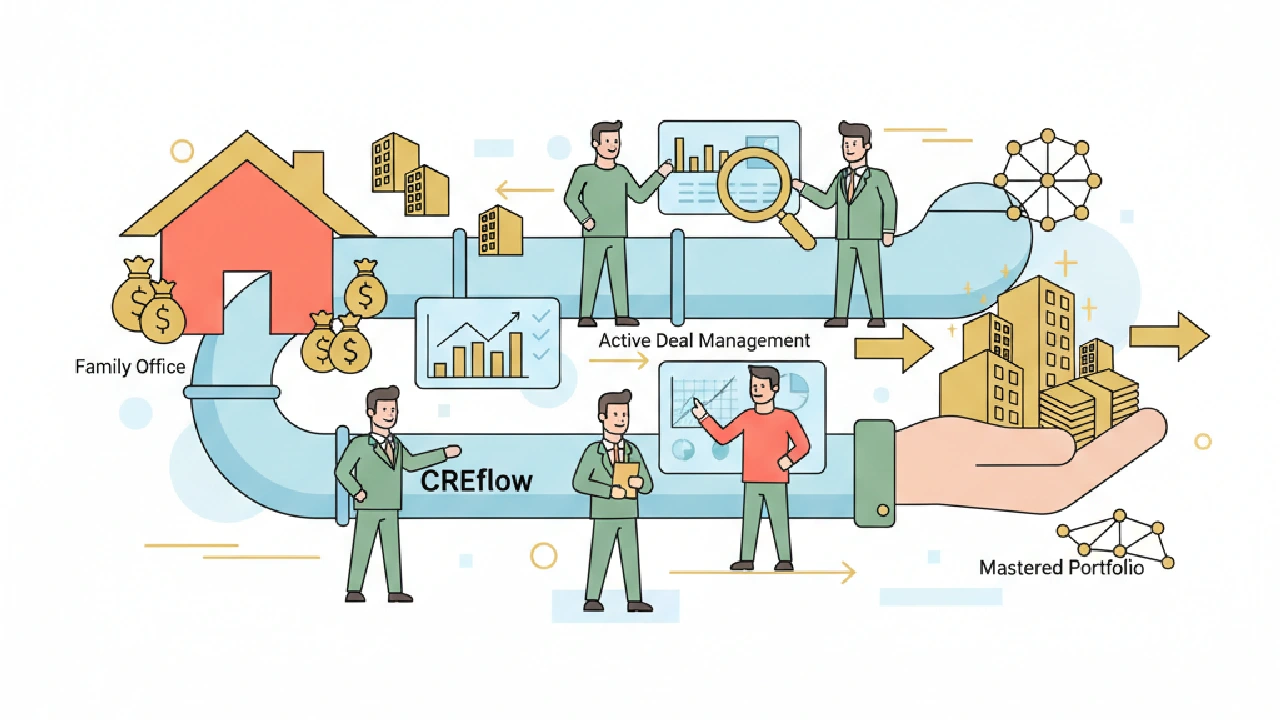
As a family office, you're not just playing in the commercial real estate sandbox; you're building empires, often with lean teams and high expectations. Managing an active pipeline isn't a side gig—it's the core of your investment strategy. A single missed follow-up on a high-value property can cost you millions in opportunity. That's why we need systems that don't just track deals but actively push them forward.
For us, success hinges on two things: speed and precision. We need to evaluate opportunities quickly, maintain rigorous follow-up, and ensure every piece of data is where it needs to be. This isn't about chasing every shiny object; it's about executing a disciplined strategy with operational excellence.
The Hidden Costs of Fragmented Data
We've all been there: a critical property detail is buried in an email chain, a contact's phone number is on a sticky note, and underwriting assumptions live in a spreadsheet on someone's desktop. This fragmented approach isn't just inefficient; it's a liability. When your deal data is scattered, you lose time, increase risk, and ultimately, miss deals.
Consider a scenario where you're evaluating a multi-tenant industrial property. The rent roll is in a PDF, the recent comps are in an Excel file, and the broker notes are in your inbox. Getting a clear picture means hours of sifting and cross-referencing. In a competitive market, that lost time is a direct cost. It delays your LOI, gives competitors an edge, and introduces errors into your underwriting.
That's why a centralized system is non-negotiable. It's not just about storage; it's about making data accessible and actionable. In CREflow, property and deal records, including contact information and deal comments, are designed to keep all critical context in one place. This means less hunting for information and more focus on analysis and negotiation. To dive deeper into how fragmented data can hinder your progress, explore 9 signs your pipeline is costing real deals.
Before You Dive into a Deal, Check This:
- Is all property information (address, type, size, owner details) in a single, accessible record?
- Are all related contacts (brokers, owners, lawyers) linked directly to the property and deal?
- Are notes and communications for the deal captured within the deal record, not spread across emails?
Automating Follow-Ups to Prevent Deals from Going Cold
Every active deal pipeline has moving parts. Brokers to call back, offers to send, diligence items to track. It's easy for things to slip through the cracks, especially when you're juggling multiple opportunities. A deal going “cold” isn't just a metaphor; it's a lost opportunity and a waste of effort. We can't afford to rely on memory or manual reminders.
Think about a typical acquisition process: you make an initial contact, tour a property, send an LOI, and then you're waiting. What's the next step if you don't hear back? When should you follow up? Without a system, it becomes a reactive scramble. This is where active management and automation come into play. CREflow's Action Center is built precisely for this—it provides a prioritized list of tasks, follow-ups, and due items, ensuring nothing gets missed. Team owners can configure deal stage triggers to automatically create action items as a deal moves from “Prospecting” to “Under Contract.” This means a “send LOI reminder” or “schedule diligence call” task appears exactly when it should, assigned to the right person.
This isn't about micromanaging; it's about creating a predictable workflow. We set the rules once, and the system enforces them, freeing us up to focus on the actual negotiation and relationship building. It means less time reminding ourselves what to do and more time actually doing it. For more insights on ensuring deals don't slip away, consider how CREflow for Solo CRE Investors: how to stop deals from slipping can help.
Before You Let a Deal Languish, Check This:
- Are there clear next steps scheduled for every active deal in your pipeline?
- Are these next steps automatically triggered by deal stage changes?
- Do you have a centralized queue (like the Action Center in CREflow) showing all due and overdue follow-ups?
Standardizing Underwriting for Consistent Evaluation
Underwriting is the backbone of any acquisition, but it can quickly become a black hole of custom spreadsheets and inconsistent assumptions. One analyst uses a 5% vacancy, another uses 10%. One uses a cap rate from a year ago, another pulls fresh data. This inconsistency creates an apples-to-oranges comparison across your pipeline, making it impossible to evaluate deals objectively.
We need a standardized framework. Not a rigid box, but a flexible template that ensures core metrics are calculated consistently. When you're looking at dozens of deals a month, you need to quickly assess NOI, cap rate, IRR, and cash-on-cash return with confidence. Without this, you're making decisions on shaky ground, potentially overpaying or missing out on solid opportunities.
The Underwriting module in CREflow provides a dedicated tab on investment deals to model these metrics. You can input deal setup (price, down payment), revenue (rent per sq ft, vacancy, escalation), expenses (OpEx, CapEx), and financing details all in one place. It generates key metrics and charts, allowing for quick adjustments and real-time analysis. This means every deal is evaluated against the same set of rules, leading to more informed and efficient decision-making.
Beyond the numbers, think about the non-financial elements. Environmental issues and other property due diligence notes also belong with the property record, not just in a folder on your drive. CREflow integrates these details directly into the property edit or detail page, ensuring all critical information is accessible when you need it for underwriting. To further improve your underwriting process, refer to Commercial Real Estate Underwriting: A Practical Guide and understand CRE Underwriting Mistakes: How to Spot & Fix Them.
Before You Model a Deal, Check This:
- Is your underwriting template standardized across all team members?
- Are all key financial metrics (NOI, cap rate, IRR) calculated using consistent assumptions?
- Are non-financial due diligence notes (like environmental issues) stored directly on the property record for easy access during underwriting?
Actionable Checklist: Streamlining Your Family Office Pipeline
- Centralize all property and contact data into a single platform like CREflow.
- Implement automated follow-up triggers based on deal stage progression.
- Standardize your underwriting assumptions and templates for all acquisitions.
- Utilize a centralized Action Center to manage daily tasks and prevent missed opportunities.
- Regularly review pipeline health and team activity for bottlenecks.
Key takeaways
- Fragmented data leads to lost time and missed opportunities.
- Automated follow-ups are crucial for preventing deals from going cold.
- Standardized underwriting ensures consistent and objective deal evaluation.
- Centralized systems like CREflow consolidate critical deal context.
- Proactive pipeline management is essential for family offices to maintain their edge.
FAQ
What does “fragmented data” mean for a family office's CRE pipeline?
Fragmented data refers to critical deal information—like property details, contact information, and underwriting assumptions—being scattered across various tools, spreadsheets, emails, and individual desktops. This makes it difficult to get a complete, real-time view of a deal, leading to inefficiencies, errors, and missed opportunities.
How can CREflow help prevent deals from going cold?
CREflow addresses this through its Action Center and deal stage triggers. The Action Center provides a prioritized, centralized list of all manual tasks and automated follow-up reminders. Deal stage triggers can be configured by team owners to automatically create specific action items (e.g., “send LOI reminder”) as a deal progresses through your pipeline stages. This ensures timely follow-ups and clear next steps for every opportunity.
Is the underwriting module in CREflow flexible enough for different property types?
The Underwriting tab in CREflow is designed for investment (acquisition) deals and allows for detailed input across various financial components like price, revenue, expenses, and financing. While it standardizes the framework, the inputs are flexible enough to accommodate different assumptions for various property types, ensuring consistent evaluation while allowing for specific deal nuances.
Can multiple team members collaborate on a deal in CREflow?
Yes, CREflow is built for team collaboration. Resources created within a team context, including properties, deals, campaigns, and contacts, are visible to all team members. Deal comments support @mentions to notify specific teammates for input, and the activity timeline provides a comprehensive history of actions taken by the team on a deal, ensuring everyone stays on the same page.
What happens to our data if we cancel our CREflow subscription?
Upon cancellation, CREflow automatically creates backup files of your data, and download links are sent to your email. If the free plan is enabled, your account may be downgraded, retaining a limited number of deals, leads, properties, and campaigns. If the free plan is disabled, your data remains in the system but becomes inaccessible unless you resubscribe. It is crucial to download your backup files before their expiration date, as they are permanently deleted afterward.