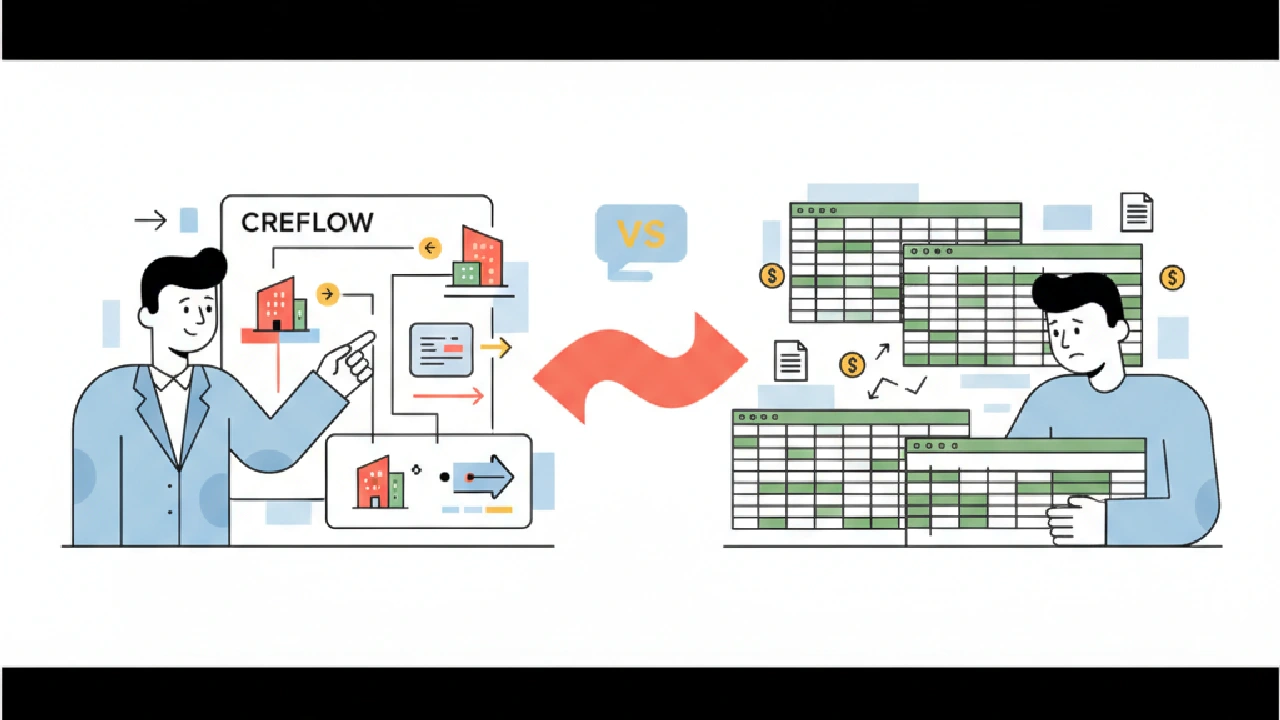
Let's be honest: almost every one of us started tracking deals in a spreadsheet. It’s the default. It’s flexible. It’s free (or feels like it). But at some point, that trusty Excel file starts to feel like a liability. We've all seen it – the multi-tab monstrosity, the broken formulas, the endless copy-pasting. So, when do you ditch the spreadsheet for something built specifically for CRE acquisition workflows, like CREflow?
The core idea here isn't about "spreadsheets are bad." It's about matching the tool to the job. If your main pain isn't building a complex model from scratch, but rather running a repeatable acquisition workflow, that’s when the conversation shifts. We’re talking about moving from a modeling tool to an operating system for your deals.
When Your Spreadsheet Becomes a Frankenstein
We’ve all inherited them or built them ourselves: the spreadsheets that grow into unmanageable beasts. You add a new deal, copy-paste a tab, update 15 cells, and pray nothing breaks. This isn't just about convenience; it's about real dollar-at-risk. Imagine chasing a lead, you're deep into diligence, and a number looks off. You trace it back and find a hard-coded value or a broken link from a month ago. That's not just wasted time; that's potentially missing a deal or, worse, making a bad one.
For most boutique acquisition teams, the biggest workflow pains that eventually force a move off spreadsheets boil down to a few key areas. It starts with the sheer volume of manual data entry. We’re talking about copying data across deal sources, rent rolls, T12s, debt assumptions, and operating budgets. This constant copy-paste creates version drift and errors that are a nightmare to track down. This isn’t a theoretical problem; it’s where mistakes creep in, and deals get delayed or mispriced. For more on this, explore common spreadsheet issues and how to fix them, or discover when it’s time to switch from a spreadsheet to dedicated deal management software.
The Collaboration Conundrum and Scaling Friction
Another major headache? Collaboration. Get more than one person touching that "master" spreadsheet, and things get messy fast. Who changed what? When? Why? Without a clear audit trail, it’s a guessing game. Someone updates a comp, another tweaks a cap rate assumption, and suddenly your team isn't on the same page. It slows everything down, breeds mistrust in the data, and makes it almost impossible to maintain consistency across deals. With CREflow's team collaboration features, you can see how CREflow helps investor teams collaborate more effectively.
Then there’s scaling. When you're only underwriting a few deals a year, a spreadsheet can often cut it. But what happens when your deal flow doubles? Or you add another team member? Your spreadsheet architecture, designed for a solo operator, buckles under the pressure. It wasn't built to handle a growing pipeline with hundreds of properties and dozens of active deals. This scaling friction means you’re spending more time managing your data than actually analyzing deals or making offers. Discover how growing CRE shops outgrow spreadsheets and find out when to make the leap from CREflow vs. Spreadsheets: When to Make the Leap.
Weak Scenario Testing: Flying Blind on Assumptions
How often do you really run multiple scenarios in your spreadsheet without rebuilding half the model? We need to quickly compare base, downside, and upside cases. We need to see what happens if rent growth changes by a point, or if we refinance in year three instead of year five. In a complex spreadsheet, that often means duplicating tabs, tweaking formulas, and hoping you caught every dependency. It’s cumbersome, time-consuming, and frankly, it discourages thorough scenario planning.
This lack of flexible scenario testing means we often make decisions based on a single, static projection. We know the market is dynamic, but our tools don't always allow us to explore that dynamism easily. This can lead to missed opportunities when a slight shift in a key assumption could uncover a hidden gem, or, conversely, prevent a costly mistake if a pessimistic scenario is truly considered. With CREflow's Underwriting module, you can model NOI, cap rate, DSCR, and IRR inside your acquisition deals, allowing you to test assumptions and scenarios in real-time without duplicating complex spreadsheets.
The Opportunity Cost of Spreadsheet Management
Beyond the direct errors and inefficiencies, there’s a significant opportunity cost. Every hour spent debugging a spreadsheet, manually updating data, or trying to reconcile conflicting versions is an hour not spent sourcing new deals, building relationships with brokers, or diving deeper into market research. For a lean acquisition team, this diversion of resources can be detrimental. It means fewer deals analyzed, slower deal cycles, and potentially lower returns.
Think about a typical week. How much time is allocated to "spreadsheet maintenance" versus "deal analysis" or "strategic planning"? If the former is creeping into double-digit percentages, it is costing you more than you think. Learn about the signs your pipeline is costing you real deals due to inefficient management.
Beyond Basic Calculations: The Power of Integrated Workflows
While spreadsheets excel at raw calculation, their weakness emerges in managing the entire deal lifecycle. Consider the interconnectedness of your work: a property you're tracking might move from an initial lead, through multiple outreach campaigns, eventually into an acquisition deal, and perhaps even a disposition later. In a spreadsheet-centric world, each of these stages often lives in a different file or tab, requiring manual updates and constant reconciliation.
This fragmentation leads to critical gaps. Did that hot lead from last month get added to the current cold-email campaign? Has the owner information on the deal sheet been updated to reflect the latest contact details in your separate contact list? How do you easily see all past interactions for a property, from initial call to site tour notes, when they're scattered across various files or even individual team members' inboxes?
An integrated platform, purpose-built for CRE acquisition teams, solves this by centralizing your data and automating these connections. When you update an owner's phone number in your CREflow Contacts, that change ripples across all linked properties and deals. Scheduling a property follow-up automatically places it on your calendar and in your prioritized Action Center, ensuring nurture work isn't lost. This holistic view of every asset and interaction means less time chasing information and more time making informed decisions, driven by a complete, up-to-date record.
The "Hidden" Opportunity: Standardizing and Scaling Success
The transition from a spreadsheet to a dedicated platform isn't just about fixing problems; it's about unlocking new opportunities for growth and efficiency. When you're relying on individual spreadsheets, every team member might have their own way of tracking data, leading to inconsistencies and making it difficult to onboard new hires or analyze team-wide performance. Standardizing your workflow across a platform means everyone follows the same process.
For instance, implementing Deal Stage Triggers ensures that when a deal moves to "Under Contract," a predefined checklist of tasks—like ordering title, scheduling an appraisal, or sending a due diligence request—is automatically generated. This eliminates missed steps and provides a consistent experience for every deal. Furthermore, the ability to track campaign performance and see property lifecycle statuses within the same system allows you to refine your outreach strategies based on actual results, rather than anecdotal evidence. This standardization is critical for scaling, as it transforms tribal knowledge into repeatable processes, empowering your team to handle a larger volume of deals with greater accuracy and less oversight.
Key Takeaways
- Spreadsheets are prone to errors, version control issues, and manual data entry burdens that increase risk and slow down deal cycles.
- Collaboration becomes challenging with spreadsheets, hindering team efficiency and making it difficult to scale operations effectively.
- Limited scenario testing in spreadsheets can lead to suboptimal decision-making by restricting the exploration of various market dynamics.
- The hidden cost of spreadsheet management is the opportunity cost: time spent on maintenance rather than on sourcing, analysis, and strategic growth.
- Adopting an integrated platform centralizes data, automates workflows, and standardizes processes, leading to increased accuracy, efficiency, and scalability for CRE acquisition teams.
FAQ
When is it truly time to move off spreadsheets?
It's time when your current spreadsheet system introduces errors, hinders collaboration, makes scenario testing cumbersome, or consumes significant time in maintenance rather than deal analysis. If your deal flow is increasing or you're adding team members, these issues become amplified.
What specific CREflow features directly address spreadsheet limitations?
CREflow addresses these limitations with features like a centralized deal pipeline, automated Action Center tasks from deal stage changes, integrated Underwriting module for scenario analysis, and comprehensive team collaboration tools with clear audit trails.
How does CREflow help with team collaboration compared to a shared spreadsheet?
CREflow's team features provide distinct user roles (Owner, Manager, Member), shared deal and property data accessible to all relevant team members, activity feeds, and @mentions in comments, eliminating version control issues and providing a clear audit trail of who did what, when.
Can I import my existing spreadsheet data into CREflow?
Yes, CREflow supports bulk import for properties and bulk import for contacts from CSV files. This allows for a smoother transition of your existing data into the platform, minimizing manual data entry during migration.
Will moving to CREflow require a complete overhaul of my underwriting models?
CREflow includes a dedicated Underwriting module within acquisition deals designed to model NOI, cap rate, and IRR. While it offers a structured approach, it's built to be flexible for various assumptions, often reducing the need for separate, complex spreadsheet models by integrating this analysis directly into your deal workflow.