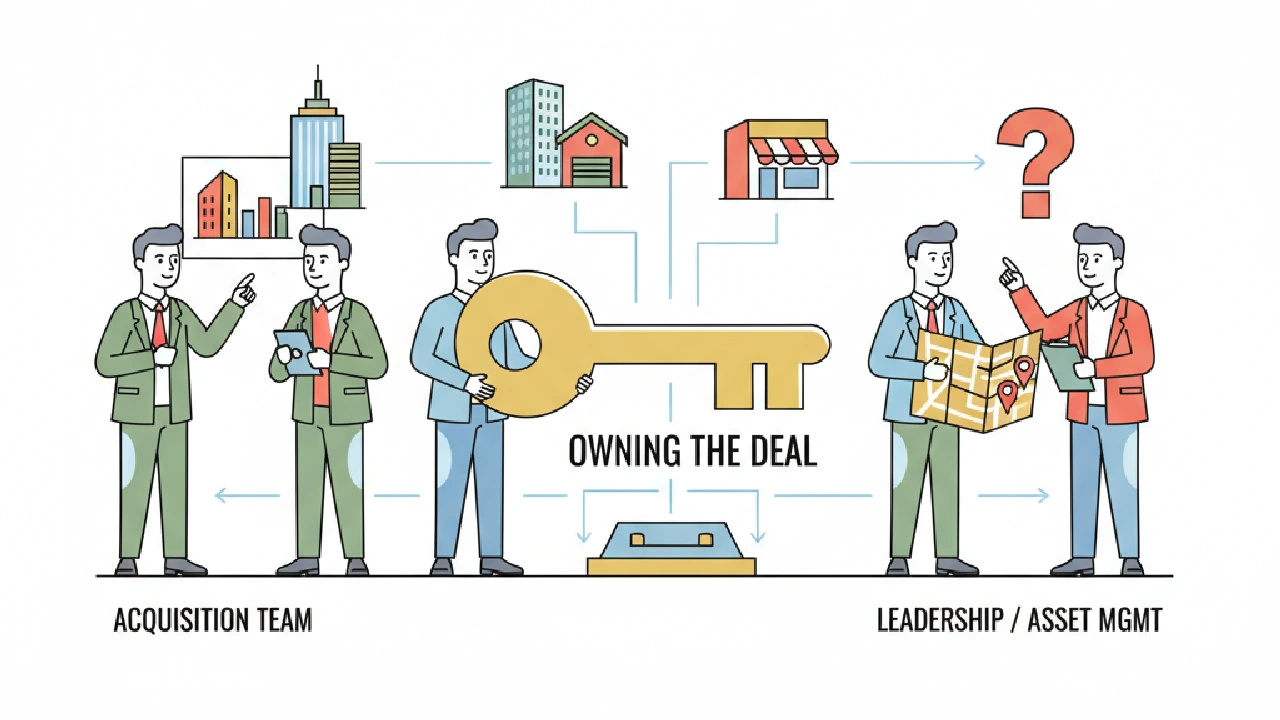
Owning the deal means one named person is accountable for every next step on a property, from the first broker call to the closing wire. On a small commercial real estate acquisition team, that person is the deal owner. Everyone else supports them: the principal approves, the analyst underwrites, and outside parties like the broker, lender and attorney deliver their pieces. Clear acquisition team roles and responsibilities come down to three things: one accountable owner per deal, a written split of who does what at each stage, and handoff rules so nothing sits between two people.
This guide is about people and process on a 2 to 5 person buy-side team. It is not about legal or entity ownership of a property; for that, see the hidden cost of unclear ownership structures in CRE.
What Is a Deal Team? Roles on a Small Acquisition Team
An acquisition team is the standing group inside your company that finds, screens, underwrites, negotiates and closes purchases. A deal team is the group working one specific property: the people from your acquisition team who are on that deal, plus the outside parties it needs.
On a small team, the same few people sit on every deal team, so titles matter less than clarity. These are the seats that usually exist, even when one person fills two of them:
Principal: sets the buy box, approves pricing and go or no-go decisions, signs the LOI and the purchase agreement, and owns relationships with equity partners.
Deal owner: the one person accountable for the deal's next step and its timeline. On a two-person team this is often the principal on early-stage deals and the analyst or associate once a deal is under contract.
Analyst: builds and maintains the underwriting, reviews the rent roll and operating statements, and keeps the numbers current as diligence findings come in.
Outside parties: the broker (seller side), the lender or debt advisor, your attorney, the title company, and third-party consultants such as environmental, property condition and survey.
The deal owner is a role, not a title. A deal owner is the person whose name sits on the deal and who answers the question "what happens next, and when?" They don't do every piece of work. They make sure every piece has someone doing it and a date attached.
Acquisition Team Roles and Responsibilities by Deal Stage
The deal owner can change between stages, but only through an explicit handoff. This table shows a common split for a small buy-side team. Adjust the names to your own seats.
| Stage | Owner | Supports | Handoff trigger |
|---|---|---|---|
| Sourcing | Principal | Broker, analyst | Offering memorandum or rent roll received and logged on the deal |
| Screening | Analyst | Principal | Deal passes or fails the buy box; principal decides whether to underwrite |
| Underwriting | Analyst | Principal, lender (early sizing) | Model reviewed; principal sets an offer range |
| LOI | Principal | Analyst, broker | LOI signed by both sides |
| Diligence | Deal owner (often the analyst or associate) | Attorney, lender, title, consultants | All diligence items cleared or a go or no-go decision made before the deposit deadline |
| Closing | Deal owner | Attorney, title, lender, principal (signing) | Funds wired, deed recorded, handoff to operations |
The handoff trigger column is the part most teams skip. A stage change should be an event someone can point to, not a feeling that the deal "has moved on."
A Simple RACI for CRE Deals
RACI is a general project management tool: for each activity, one person is Responsible (does the work), one is Accountable (owns the outcome and signs off), some are Consulted (give input before), and some are Informed (told after). The rule that matters most is that each activity has exactly one A.
Here is an example matrix for a 3-person team: a principal, an analyst and an associate who acts as deal owner once a deal is under contract.
| Activity | Principal | Analyst | Associate (deal owner) | Outside parties |
|---|---|---|---|---|
| Broker relationship and first call | A, R | I | I | Broker: C |
| Screen against the buy box | A | R | I | |
| Underwriting model | A | R | C | Lender: C |
| LOI terms and negotiation | A, R | C | I | Broker: C |
| Diligence request list and tracking | I | C | A, R | Attorney, title: C |
| Third-party reports (environmental, property condition, survey) | I | C | A, R | Consultants: R |
| Lender document requests | I | R (financials) | A | Lender: C |
| Go or no-go before the deposit deadline | A | C | R | Attorney: C |
| Closing coordination | C | I | A, R | Attorney, title: R |
On a 2-person team, collapse the analyst and associate columns into one. The matrix still works as long as every row keeps one A.
One Owner per Due Diligence Workstream
The deal owner holds the overall timeline, but diligence moves faster when each workstream has its own named owner too. Split the work into five streams and put one name and one deadline next to each:
Financial. T12, rent roll, leases and service contracts. Usually the analyst, since they built the model.
Physical. Property condition report, site visit notes and capital needs. Often the deal owner, working with the inspector.
Legal. Title, survey, estoppels and the purchase agreement. The deal owner tracks each item; your attorney does the review.
Environmental. Phase I ordered on day one, plus any follow up work it calls for. One person watches the report date against the deposit deadline.
Financing. Lender document requests and the appraisal. The deal owner manages the lender, and the analyst supplies the numbers.
On a 2 or 3 person team one person will hold more than one stream, and that is fine. What matters is that nobody has to ask who is chasing a missing item. Use our commercial real estate due diligence checklist to see what belongs in each stream.
Handoffs Where Follow-Ups Get Dropped
Most dropped balls on small teams happen at a handoff, when each person reasonably believes the other one has it. These are the common ones and a rule for each:
Broker callback after a tour. The person who walked the property owns the callback and its date. If the principal toured but the analyst is underwriting, the principal still makes the call and logs what was said.
LOI counter. The principal owns the response. The analyst owns updating the model to the counter's terms, with a date for both written on the deal.
Diligence requests. One person owns the request list sent to the seller and tracks each item until received. Other team members send their requests through that person, not straight to the seller.
Lender asks. The deal owner owns the lender relationship during diligence, even when the analyst prepares the financials. If the deal needs a Phase I environmental site assessment (the usual way buyers meet the EPA All Appropriate Inquiries rule), ordering it should have an owner and a date on day one of diligence.
A simple rule covers all four: no handoff is done until the new owner confirms it. "I sent it to you" is not a handoff. "I have it, and the next step is Thursday" is.
If the same handoff keeps failing even with clear roles, the cause may be the system, not the people. Why follow-ups slip is usually a system problem covers that side, and follow-up discipline at higher lead volume covers keeping up as deal count grows.
Signs of a Lack of Ownership and Accountability
A deal has no written next step, or the next step has no date.
You hear "I thought you had it" after a deadline passes.
Two people send the seller or broker the same request.
Nobody can say, without checking, which deals are in diligence and when each deposit deadline is.
The team relies on a weekly meeting to find out what happened on each deal. See how small CRE teams stay aligned without a weekly meeting.
The deal list lives in a shared spreadsheet that nobody fully trusts. That usually breaks as the pipeline grows; see when a deal spreadsheet stops working.
What Should a Deal Owner Check Every Week?
Once roles are set, the natural next question is what the deal owner actually reviews to keep each deal moving. A short weekly pass works for most small teams:
Every active deal has a next step with a date. If it doesn't, add one or decide the deal is dead.
Contract dates are visible. Diligence end, deposit deadlines and closing date for every deal under contract.
Open diligence items. What has been requested, what has been received, and who is waiting on whom.
Underwriting is current. If diligence changed rents, expenses or the loan terms, the model reflects it before any go or no-go decision.
Overdue and cold follow-ups. Brokers, sellers and lenders who were supposed to hear back and haven't.
For the full list of what to collect and review under contract, use the commercial real estate due diligence checklist.
How CREflow Pro Supports Clear Deal Roles
Clear roles are a team habit first, but they are easier to keep when everyone works from the same deal record. CREflow Pro gives small acquisition teams:
A drag-and-drop acquisition pipeline, so everyone sees which stage each deal is in.
A follow-up list of what's due today, what's overdue and what has gone cold.
Due diligence checklists, milestones and contract dates tracked on each deal.
Team collaboration and team activity tracking on the Team plan, plus reporting on team activity.
For step-by-step setup, see setting up stages, reminders and deal ownership in CREflow Pro and CREflow Pro for acquisition teams.
Run the numbers on your next deal with the free CREflow Pro underwriting tool, or see CREflow Pro plans when your team is ready to work from one pipeline.
FAQ
What is a deal owner?
The deal owner is the one person accountable for a deal's next step and timeline. They don't do all the work, but they make sure every piece of work has someone doing it and a date attached.
What is a deal team?
A deal team is everyone working on one specific property: the members of your acquisition team on that deal plus outside parties such as the broker, lender, attorney, title company and consultants.
What are the roles on a real estate acquisition team?
On a small team the core roles are the principal (approves and negotiates), the analyst (underwrites and reviews financials) and the deal owner (drives the next step and the timeline), supported by outside parties. One person can hold more than one role.
Who owns the next step after a broker call?
The person who took the call. They log what was said and set the next step with a date, even if a teammate will do the follow-up work.
Does RACI work for a 3-person team?
Yes, if you keep it short. List the 8 to 10 activities that matter on every deal and make sure each one has exactly one accountable person. Skip the rest.
Who should own each due diligence workstream?
Give each of the five streams (financial, physical, legal, environmental and financing) one named owner and a deadline. On a small team the analyst usually takes financial, and the deal owner takes the rest with help from the attorney, inspector and lender. One person can own several streams, but every stream needs exactly one.
Is deal ownership the same as legal ownership of a property?
No. Deal ownership in this guide means who on your team is accountable for moving a deal forward. Legal and entity ownership is about who holds title and controls the asset; see the hidden cost of unclear ownership structures in CRE.