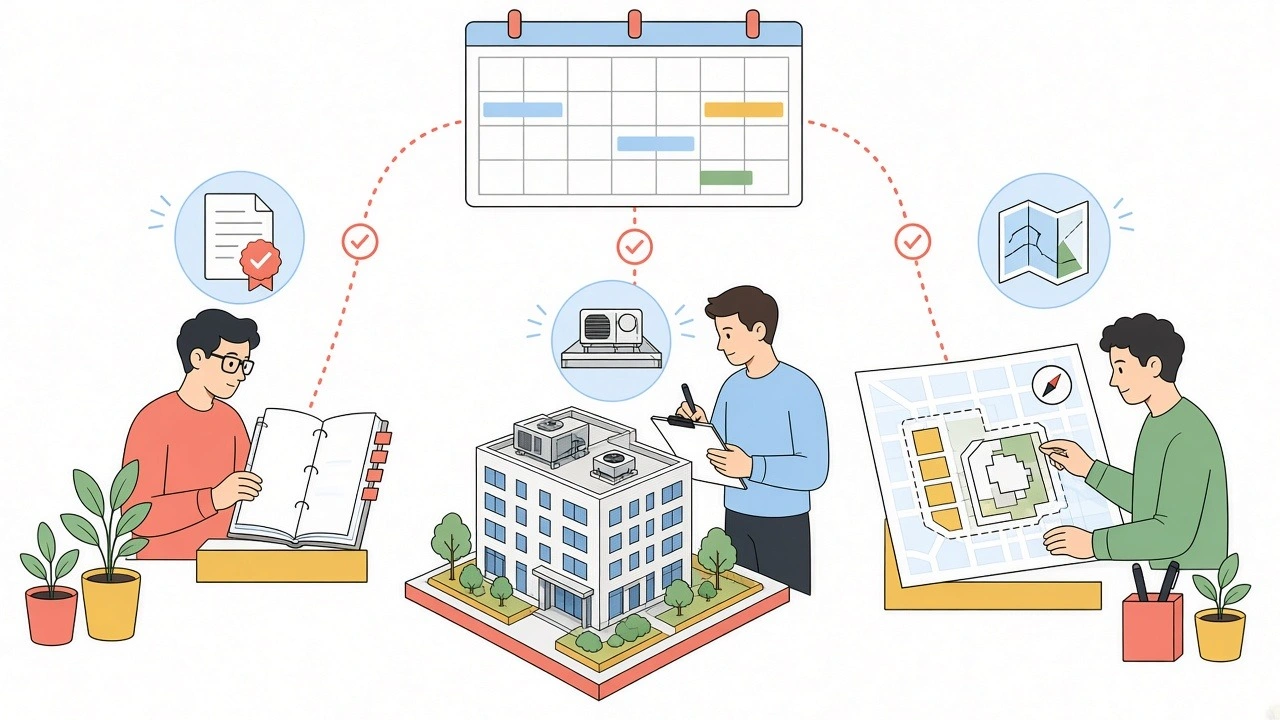
To run parallel due diligence workstreams on a CRE acquisition, split the work into separate workstreams (title and survey, legal and leases, physical condition, environmental, financial, insurance, and capital and closing), give each one a single owner, start every workstream that has a long lead time in the first days after the contract is signed, map which workstreams depend on others, and review all of them together on one short weekly standup against the contract dates. The goal is simple: no workstream should be the reason you run out of time before the due diligence period ends. This guide is general education, not legal, tax or investment advice. Have a qualified real estate attorney and your own advisors review any deal before you commit capital.
What is a due diligence workstream in a CRE acquisition?
A due diligence workstream is one area of investigation, such as title, environmental or the rent roll, with its own owner, outside advisors, documents and deadline.
Thinking in workstreams instead of one long checklist changes how a small team works. A checklist tells you what has to be checked. A workstream tells you who is driving it, who they are waiting on, and when it must be done for the deal to stay on schedule. If you need the full list of items to review, start with the commercial real estate due diligence checklist. This post is about coordinating that list so the pieces move at the same time.
Which workstreams run in parallel on a typical acquisition?
The seven workstreams below cover most small acquisitions, and nearly all of them can start as soon as the purchase agreement is signed and the seller delivers documents.
Your purchase and sale agreement sets the dates. Read it first so every owner knows the deadlines they are working against. See how a commercial real estate PSA works and how the due diligence period works for the terms that usually matter.
| Workstream | What it covers | Typical owner on a small team | Outside help often involved |
|---|---|---|---|
| Title and survey | Title commitment, exceptions, easements, survey, zoning | Deal lead or closing coordinator | Title company, surveyor, attorney |
| Legal and leases | Leases, amendments, estoppels, service contracts, entity documents | Deal lead | Real estate attorney |
| Physical condition | Property condition assessment, roof, building systems, capex needs | Asset or construction lead | Property condition consultant, specialty inspectors |
| Environmental | Phase I environmental site assessment and any follow up | Deal lead | Environmental consultant |
| Financial | T-12, rent roll, operating expenses, tax bills, underwriting updates | Analyst | Accountant |
| Insurance | Quotes, loss runs, flood zone, coverage requirements | Analyst or deal lead | Insurance broker |
| Capital and closing | Equity commitments, closing funds, closing statement | Principal | Attorney, title company, partners |
On a two or three person team one person will own several workstreams. That is fine. What matters is that each workstream has exactly one name next to it, so nothing is owned by "the team."
How do you assign due diligence workstream owners?
Give each workstream one internal owner who is accountable for its outcome, even when outside advisors do most of the work.
The owner does not have to do the analysis. The owner makes sure the request went out, chases the answer, reads the report and tells the team what it means for the deal. A few rules keep ownership clear:
- One owner per workstream, written down on day one.
- The owner holds the relationship with the outside advisor for that workstream.
- The owner sets an internal due date that is earlier than the contract date, so there is time to react to bad news.
- The owner flags a blocked item at the next standup instead of waiting for it to clear.
For more on why clear ownership matters across the whole pipeline, see how to set deal ownership on a CRE team.
Which workstreams should start first?
Start the workstreams with the longest lead times and the outside parties you do not control first: third party reports, title and survey, and the seller's document delivery.
Ordering reports on the first business days after the contract is signed is one of the biggest schedule decisions you make. Reports from consultants, surveyors and title companies take time you cannot get back later. A practical first week looks like this:
- Confirm the contract dates and write them where the whole team can see them.
- Send the seller a document request list based on the contract's delivery requirements.
- Order title and survey.
- Engage the environmental consultant for a Phase I environmental site assessment.
- Engage the property condition consultant and schedule site access.
- Ask your insurance broker for quotes and the information they need.
- Start reviewing leases and the rent roll as soon as they arrive.
For the environmental workstream, the Phase I is the step most buyers use to meet the EPA's All Appropriate Inquiries rule, which matters for certain liability protections. For the physical workstream, consultants commonly work to the ASTM E2018 standard for property condition assessments. For title, your title company and attorney will work from the ALTA policy forms. Ask your advisors which standards and scope apply to your deal.
How do you track dependencies between workstreams?
A dependency is any item in one workstream that cannot finish until another workstream delivers something, and you track it by writing both sides down with a date.
Parallel workstreams are not fully independent. Common dependencies on an acquisition include:
| This item | Depends on | Why it matters |
|---|---|---|
| Final underwriting | Rent roll and lease review, capex findings, insurance quotes, tax bills | Your numbers are only as current as the slowest input |
| Estoppel review | Lease review | You need the lease terms to know what the estoppel should confirm |
| Title objections | Title commitment and survey | Survey matters often drive title objections |
| Price or credit discussion | Physical and environmental reports | You need findings in hand before you ask the seller for anything |
| Insurance binding | Physical findings, flood zone, lender or partner requirements | Coverage depends on what the property actually is |
| Go or no go decision | Every workstream | Nothing should be open when the due diligence period ends |
When a dependency slips, the owner who is waiting should raise it, not the owner who is late. That keeps problems visible early. For the leases side, the commercial lease due diligence checklist and the guide to estoppel certificates go deeper. For physical findings, see how to build a capex budget during due diligence.
How should a weekly diligence standup work?
A weekly diligence standup is a short, fixed meeting where every workstream owner reports status, blockers and findings against the contract dates.
Keep it short and the same every week. Each owner answers four questions:
- What finished since last week?
- What is still open, and what is its internal due date?
- What is blocked, and who is it waiting on?
- Did anything change the price, the plan or the go or no go view?
End each standup by restating the days left in the due diligence period and any decision the principal needs to make before the next one. Add a second standup in the final stretch before a contract deadline if items are still open. When processes tend to fail, it is usually at the handoffs, which where diligence processes usually break covers in detail, and how to keep due diligence from stalling a deal covers momentum.
How do you keep workstreams visible without spreadsheets everywhere?
Keep every workstream's checklist, owner, dates and documents attached to the deal itself, so the whole team reads from one record.
Many small teams start with one spreadsheet per deal plus email threads, and the status ends up scattered. As manual task tracking creates pipeline blind spots explains, scattered status is how items get missed.
In CREflow Pro, each deal can carry due diligence checklists, milestones and contract dates, with LOIs, leases and T-12s attached, and you can share a checklist by link with someone outside the team. You can also track inspections through closing and keep underwriting (NOI, cap rate, DSCR and IRR) inside the same deal record, so updated numbers sit next to the diligence that changed them. CREflow Pro is not a virtual data room and does not order third party reports, so your advisors still deliver their work the usual way. To update the numbers as findings come in, try the free CRE underwriting calculator or the pro forma generator, and see CREflow Pro pricing when you want it all on one deal record.
What should you do when one workstream falls behind?
When a workstream falls behind, find out early, decide whether the delay threatens a contract date, and then choose between speeding it up, narrowing it, or asking for more time.
The options are usually limited and they work best when used early:
- Escalate with the outside party. Ask the consultant, title company or seller exactly what they need and when they will deliver.
- Narrow the open question. Sometimes you only need one answer from a report, not the final version, to make a decision. Ask your advisor whether that is possible.
- Ask for an extension. If a contract date is at risk, talk to your attorney about requesting an extension in writing well before the deadline, under the terms of your agreement.
- Decide without it. If none of the above works, the principal decides whether the remaining risk is acceptable or whether to walk away under the contract terms.
Whatever you choose, record the decision and who made it. Your attorney should confirm what your contract allows before you rely on any extension or termination right.
Frequently asked questions
How many due diligence workstreams does a small CRE acquisition need?
It depends on the property and the contract, but most small deals cover title and survey, legal and leases, physical condition, environmental, financial, insurance, and capital and closing. Smaller deals may combine some of them under one owner.
Can one person own several workstreams?
Yes. On a small team that is normal. Each workstream should still list one owner, and that person should have internal due dates for each one.
What is the difference between a due diligence checklist and a workstream plan?
A checklist lists the items to review. A workstream plan adds owners, start dates, dependencies and a review cadence so the items get done in time.
When should third party reports be ordered?
As early as your contract and budget allow, usually right after the agreement is signed, because these reports often have the longest lead times. Confirm scope and timing with each consultant.
Does CREflow Pro replace a data room?
No. CREflow Pro tracks diligence checklists, milestones, contract dates and attached documents on each deal. It is not a virtual data room or a report ordering tool.
This article is general information, not legal, tax or investment advice. Have a qualified real estate attorney and your own advisors review your purchase agreement, due diligence scope and any decision to extend, renegotiate or terminate before you act.