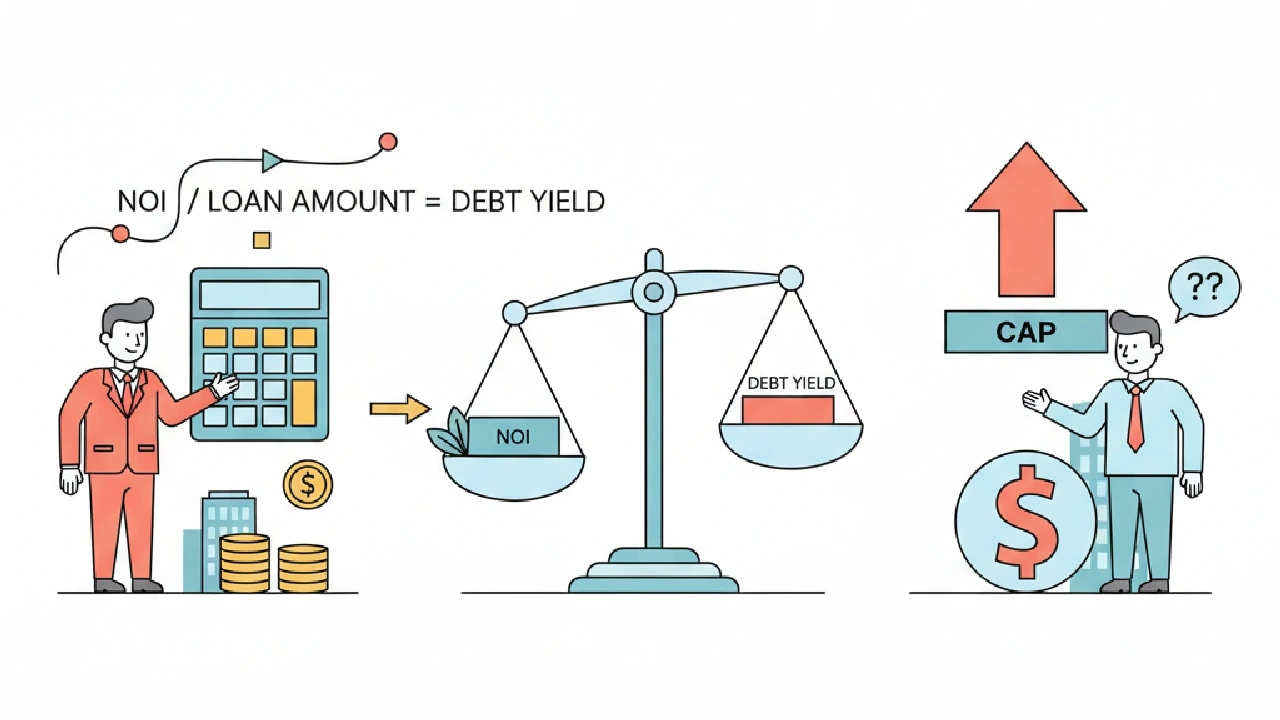
Debt yield in commercial real estate is a property's net operating income (NOI) divided by the loan amount, shown as a percent. If a property earns $500,000 of NOI and you want a $6,000,000 loan, the debt yield is 8.3%. Lenders use it to cap loan size because it ignores the loan's rate, amortization and the cap rate used for value, so it shows how much income backs every dollar of debt. If your lender sets a minimum debt yield, your maximum loan is simply NOI divided by that minimum.
This guide covers the formula, a worked example, how debt yield compares with DSCR and LTV, and how to back out your maximum loan before you write an offer.
What is debt yield in commercial real estate?
The Office of the Comptroller of the Currency defines debt yield in its Comptroller's Handbook on Commercial Real Estate Lending as "the ratio of NOI to debt," calculated by dividing NOI by the loan amount. The same handbook says it "provides a measurement of risk that is independent of the interest rate, amortization period, and capitalization rate," and that lower debt yields mean higher leverage.
Put simply, debt yield answers one question: if the lender had to take the property back on day one, what return would the property's income give them on the money they lent? A higher debt yield means more income per dollar of loan, which is safer for the lender.
The debt yield formula
Debt yield = NOI / loan amount × 100
Two versions of the formula come up often:
- Solving for debt yield: NOI / loan amount. Use it to test a loan you have been quoted.
- Solving for maximum loan: NOI / minimum debt yield. Use it to see how much a lender with a debt yield test will lend against your NOI.
Everything depends on the NOI figure, so get that right first. NOI is effective gross income minus operating expenses, before debt service and capital items. Our guides on reading a rent roll and commercial real estate underwriting walk through building an NOI you can defend.
Debt yield example: finding your maximum loan
The numbers below are an illustrative example, not market data or a real deal.
| Item | Example value | How it is calculated |
|---|---|---|
| Purchase price | $7,500,000 | Given |
| NOI | $500,000 | From your underwriting |
| Going-in cap rate | 6.67% | $500,000 / $7,500,000 |
| Loan requested | $6,000,000 | 80% of price |
| Debt yield on the request | 8.33% | $500,000 / $6,000,000 |
| Lender's minimum debt yield (example) | 9.0% | From the term sheet |
| Maximum loan under the debt yield test | $5,555,556 | $500,000 / 0.09 |
| Maximum loan under a 75% LTV test (example) | $5,625,000 | $7,500,000 × 0.75 |
In this example the debt yield test, not LTV, sets the loan: the lender would size the loan at about $5.56 million, so the buyer needs roughly $444,000 more equity than they planned at 80% leverage. Lenders typically run every test on the term sheet (debt yield, DSCR and LTV) and lend the lowest amount that passes all of them.
There is also a quick shortcut that connects the three metrics: debt yield = cap rate / LTV. In the example, 6.67% / 0.75 = 8.89%, which matches $500,000 / $5,625,000. When cap rates are low, a normal LTV can still produce a low debt yield, which is exactly the situation the OCC handbook says debt yield is useful for.
Debt yield vs DSCR vs LTV
| Metric | Formula | What it depends on | What it tells the lender |
|---|---|---|---|
| Debt yield | NOI / loan amount | NOI and loan size only | Income backing each dollar of debt, regardless of loan terms or value |
| DSCR | NOI / annual debt service | NOI plus the loan's rate and amortization | Whether income covers the payments |
| LTV | Loan amount / property value | Appraised value, which depends on the cap rate | How much equity cushion sits below the loan |
The OCC handbook defines DSCR as NOI divided by annual debt service and notes that the right level depends on the amortization period and how volatile the cash flow is. Because DSCR and LTV both move with loan terms and valuations, a lender can use debt yield as a check that does not. The handbook adds that debt yield should be considered alongside other criteria and supported by prudent DSCR and LTV ratios, so expect all three on most term sheets.
For a broader look at which return metrics buyers should track, see cap rate vs cash-on-cash vs IRR.
NOI vs NCF debt yield and stabilized debt yield
- NOI debt yield uses net operating income.
- NCF debt yield uses net cash flow, which is NOI after deducting reserves for items like capital expenditures, tenant improvements and leasing commissions. It is lower than NOI debt yield for the same loan, so always confirm which one a term sheet means.
- In-place vs stabilized debt yield: in-place uses the property's current income; stabilized uses projected income after a business plan such as lease-up or renovation. On value-add deals, ask whether the lender's test applies to today's NOI, the stabilized NOI, or both.
What is a good debt yield?
There is no single number. The OCC handbook says debt yields "vary according to market conditions and property types, with higher debt yields recommended for riskier properties." The minimum that matters for your deal is the one on your lender's term sheet, and it can differ by lender, loan program and asset type. Get that number early, before you set your offer price, rather than relying on a figure you heard for a different property type or market.
How can you raise your debt yield or close a loan-size gap?
If the debt yield test cuts your loan below what your offer needs, you have a few levers. Each comes from the formula itself: raise the NOI the lender will underwrite, or lower the loan amount.
- Bring more equity. The direct fix. Rerun your returns with the smaller loan to make sure the deal still works for you and your partners.
- Revisit the price. If the debt yield test exposes that the income does not support the price, that is useful information for your offer or for a renegotiation after diligence. Our post on retrades in commercial real estate covers when that conversation is fair.
- Document the NOI. Lenders underwrite income they can verify. Clean rent rolls, signed leases and a reconciled T12 help make sure the lender's NOI is not lower than yours for lack of support.
- Compare loan types. Different programs size loans differently. See our overview of types of commercial real estate loans, bridge loans, and bridge vs permanent loans for $2M to $10M deals.
Run the numbers before you write the LOI
Debt yield is easy to calculate once your NOI is solid. Use the free CREflow Pro underwriting calculator to model NOI, cap rate and DSCR with no account, then divide that NOI by your target loan to check debt yield against the lender's minimum. When you want the numbers to live with each deal, CREflow Pro keeps in-deal underwriting next to your pipeline, contacts and follow-ups. See CREflow Pro plans.
This article is general education, not lending, legal or investment advice. Confirm every loan sizing test with your lender.
FAQ
What is debt yield in commercial real estate?
Debt yield is NOI divided by the loan amount, shown as a percent. It measures how much property income supports each dollar of debt, without depending on the loan's rate, amortization or the cap rate.
How do you calculate debt yield?
Divide the property's NOI by the loan amount and multiply by 100. For example, $500,000 of NOI on a $6,000,000 loan is an 8.33% debt yield.
How do you calculate the maximum loan from a debt yield?
Divide NOI by the lender's minimum debt yield. With $500,000 of NOI and a 9% minimum, the maximum loan is about $5,555,556.
Is a higher debt yield better?
For the lender, yes: a higher debt yield means more income per dollar lent and lower leverage. For a borrower, a higher required debt yield means a smaller loan.
What is the difference between debt yield and DSCR?
DSCR divides NOI by annual debt service, so it changes with the loan's rate and amortization. Debt yield divides NOI by the loan amount, so it does not. Lenders often apply both and lend the lower amount.
What is a good debt yield?
It depends on the lender, property type and market. Riskier properties usually need a higher debt yield. Use the minimum on your lender's term sheet rather than a general rule of thumb.